Full body workout routine: free 3 day plan and spreadsheet
Intermediate · 3 days a week · Run it for as long as the weights keep rising · Full-body strength and muscle with heavy, medium and volume days
A three-day full body plan for lifters past the first few months: one heavy day, one medium day and one volume day, so every muscle gets worked more than once a week without every session being a max effort.
Free. The spreadsheet needs no account.
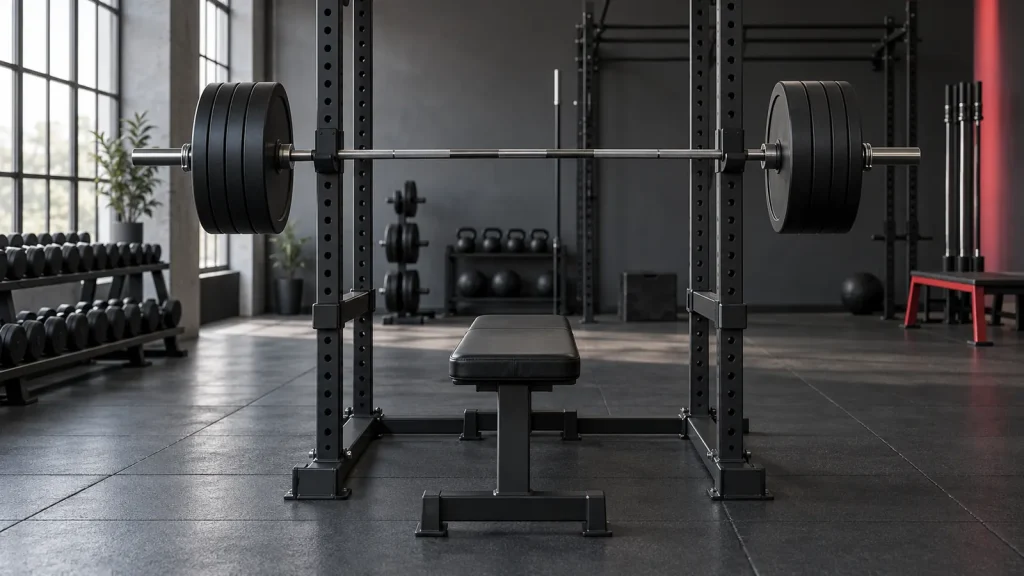
How Full body workout routine (3 days a week) works
You train three non-consecutive days a week, usually Monday, Wednesday and Friday. Each day works the legs, the push, the pull and the hips, but the emphasis changes. Day 1 is heavy: back squat and bench press for four sets of six, then barbell rows for three sets of eight. Day 2 is medium: deadlift for three sets of five, overhead press for three sets of eight and pull-ups. Day 3 is volume: front squat for three sets of eight, incline bench press for ten, cable rows for twelve and Romanian deadlifts for ten.
The point of the three-day wave is that the heavy work is spread out. Squat and bench get a heavy session early in the week, then a lighter, higher-rep variation on Friday. The deadlift gets its own day with only the press and the pull-ups beside it, so it is not stacked on top of heavy squats.
The in-app template adds a few smaller lifts that the spreadsheet leaves out because they do not need a barbell number: face pulls on day 1, split squats and hanging leg raises on day 2, lateral raises on day 3. They are there to fill in shoulders, single-leg work and trunk. Do them after the main lifts, with 15 reps for face pulls and lateral raises and 10 to 12 for the rest.
A full body split gives each muscle group two to three sessions a week. A 2016 meta-analysis by Schoenfeld, Ogborn and Krieger found that training each muscle twice a week produced more growth than once a week when total volume was matched, which is the main reason to prefer this layout to a one-body-part-a-day split. The same analysis could not say whether three sessions beat two.

The schedule
Train on Monday, Wednesday, Friday, or any other days with rest between. Every set uses the same weight, the one you can lift for the written reps.
Day 1: Heavy
| Lift | Sets and reps |
|---|---|
| Back squat | 4 x 6 |
| Bench press | 4 x 6 |
| Barbell row | 3 x 8 |
Day 2: Medium
| Lift | Sets and reps |
|---|---|
| Deadlift | 3 x 5 |
| Overhead press | 3 x 8 |
Day 3: Volume
| Lift | Sets and reps |
|---|---|
| Front squat | 3 x 8 |
| Incline bench press | 3 x 10 |
| Seated cable row | 3 x 12 |
| Romanian deadlift | 3 x 10 |
Progression and stall rules
Add weight when every set is clean
This is our own rule. If you finish every set of a lift at the listed reps with good form, add 5 lb (2.5 kg) to it the next time that day comes around. Each lift moves once a week, so the jumps are small and last a long time.
Repeat the weight after a miss
If you fall short on any set, keep the same weight next week and try to beat last week's reps. A miss on one lift does not stop the others from moving up. This is also our own rule.
Deload after two weeks of misses
If a lift misses its reps two weeks in a row, take about 10% off and build back up. Do the same for the whole routine if most lifts stall together, and look at sleep and food before changing the plan.
Keep one or two reps in reserve
Stop each set with a rep or two left, except the last set of the heavy day lifts, which can be close to your limit. Grinding every set on every day makes the week's third session worse.
Weekly volume
Work sets per lift, counted from the schedule above (warm-ups not included).
| Lift | Sets per week |
|---|---|
| Back squat | 4 |
| Bench press | 4 |
| Barbell row | 3 |
| Deadlift | 3 |
| Overhead press | 3 |
| Front squat | 3 |
| Incline bench press | 3 |
| Seated cable row | 3 |
| Romanian deadlift | 3 |
Who it suits
A good fit
- Lifters with a few months of consistent barbell training who have outgrown adding weight every session.
- Anyone who can only train three days a week and wants every muscle group hit more than once.
- People who want strength and size from one plan, without a separate hypertrophy block.
Look elsewhere if
- Complete beginners who have never squatted or deadlifted. Start with a lower-volume plan and learn the lifts first.
- Lifters who want a competition peaking plan with percentage-based weeks. This routine is weight-and-reps, not percentage-based.
- Anyone who prefers a single focus per session or who can train five or six days. A split gives more volume per muscle in that case.
Common mistakes
Making every day heavy
The medium and volume days are meant to be lighter on the nervous system. If you grind the Wednesday and Friday sets, you will not have anything left for next Monday.
Skipping the pulling
Rows, pull-ups and cable rows balance the bench and presses. Drop them and the shoulders and upper back fall behind the chest.
Chasing the same jump on every lift
Squat and deadlift will outrun the rows and the press. Let each lift move at its own pace, and use smaller jumps for the lifts that are slowing down.
Training through a bad week
A short night or a rough week is a reason to hold the weight, not to push it. Repeat the weight and keep the schedule.
Training on back-to-back days
Three full body sessions need a rest day between them. Monday, Tuesday and Wednesday leaves the third day under-recovered.
Your sample week
For each lift, enter: Weight you can lift for the reps listed on that day. The weights below update as you type. Your numbers stay in your browser and are not saved. The numbers shown are an example lifter.
Day 1: Heavy
| Set | Reps | Weight (lb) |
|---|---|---|
| 1 | 6 | 185 |
| 2 | 6 | 185 |
| 3 | 6 | 185 |
| 4 | 6 | 185 |
| Set | Reps | Weight (lb) |
|---|---|---|
| 1 | 6 | 135 |
| 2 | 6 | 135 |
| 3 | 6 | 135 |
| 4 | 6 | 135 |
| Set | Reps | Weight (lb) |
|---|---|---|
| 1 | 8 | 115 |
| 2 | 8 | 115 |
| 3 | 8 | 115 |
Day 2: Medium
| Set | Reps | Weight (lb) |
|---|---|---|
| 1 | 5 | 225 |
| 2 | 5 | 225 |
| 3 | 5 | 225 |
| Set | Reps | Weight (lb) |
|---|---|---|
| 1 | 8 | 85 |
| 2 | 8 | 85 |
| 3 | 8 | 85 |
Day 3: Volume
| Set | Reps | Weight (lb) |
|---|---|---|
| 1 | 8 | 135 |
| 2 | 8 | 135 |
| 3 | 8 | 135 |
| Set | Reps | Weight (lb) |
|---|---|---|
| 1 | 10 | 105 |
| 2 | 10 | 105 |
| 3 | 10 | 105 |
| Set | Reps | Weight (lb) |
|---|---|---|
| 1 | 12 | 100 |
| 2 | 12 | 100 |
| 3 | 12 | 100 |
| Set | Reps | Weight (lb) |
|---|---|---|
| 1 | 10 | 155 |
| 2 | 10 | 155 |
| 3 | 10 | 155 |
The spreadsheet
The file has three sheets: your numbers, the full week with every weight as a formula, and a progress table that carries the weights forward. It opens in Excel, Numbers and LibreOffice. The weights in the link below use the numbers you typed above.
Open it in Google Sheets
- Download the .xlsx file above.
- Go to Google Drive and choose New, then File upload, and pick the file.
- Double-click the uploaded file and choose Open with Google Sheets.
- Choose File, then Save as Google Sheets so you can edit it.
Want the weights to follow you into the gym? Create a free account and the program loads into Train for you.
How it compares
Full body workout routine (3 days a week) vs Starting Strength
Starting Strength is the first plan to run: two alternating full body workouts of 3x5 with weight added every session. This routine is what you move to when session-to-session jumps stop, with a heavy, a medium and a volume day instead of two identical workouts. Read the Starting Strength guide.
Full body workout routine (3 days a week) vs StrongLifts 5x5
StrongLifts is also three full body days, but it is five lifts, mostly 5x5 with a single set of five on the deadlift, and the bar gets heavier every workout. This routine uses fewer sets on the heavy lifts, more variety and weekly progression. Read the StrongLifts 5x5 guide.
Full body workout routine (3 days a week) vs Strength training for women
Our women's guide is a beginner full body plan of two alternating workouts with a clear add-weight rule. This routine is the next step for any lifter, with more lifts per week and a built-in heavy, medium and volume structure. Read the Strength training for women guide.
Full body workout routine (3 days a week) vs 3 day workout split
Also three days a week, but divided into an upper day, a lower day and a full body day, with more exercises per day. Pick it if you like dedicated upper and lower sessions; pick this routine if you want heavy, medium and volume work for the whole body each day. Read the 3 day workout split guide.
Full body workout routine (3 days a week) vs Dumbbell full body workout
A beginner dumbbell version of the same three-day idea. Pick it if you train at home with dumbbells and a bench; pick this routine once you have a barbell and rack. Read the Dumbbell full body workout guide.
Load Full body workout routine (3 days a week) into Train and log each session against the plan.
Start it in Symmetric StrengthThe workouts in Train are a simplified version of this program, with one rep count per lift. Use the schedule above for the exact sets.
Common questions
How many days a week should I do a full body workout?
Three is the usual answer, with a rest day between sessions. The US Centers for Disease Control and Prevention says adults need muscle-strengthening activity on at least two days a week that works all the major muscle groups, so a three-day plan covers that with room to spare.
Is a full body workout routine better than a split?
It depends on how many days you have. With three days, full body can give each muscle group up to three exposures a week. A body-part split on three days would hit each one once. The 2016 frequency meta-analysis favored twice a week over once when volume was matched, which supports the full body layout for a three-day schedule.
Can I do it at home?
The main lifts here need a barbell, a rack, a bench and a cable station. At home, you can swap in dumbbell versions of each lift, keeping the same sets and reps, and use bands for the cable row. Our dumbbell full body guide is built for that setup if you would rather follow a plan made for it.
How long should a session take?
Plan on about an hour. Our rest times are two to three minutes between the heavy compound sets and about a minute between lighter accessory sets.
What do I do when I stall?
Repeat the weight for a week, then take about 10% off the lift if it misses twice in a row. If most lifts stall at once, take a lighter week for the whole routine, then resume.
How is this different from the beginner guides?
The beginner programs here add weight every session and use the same few lifts every day. This routine rotates heavy, medium and volume days, adds more lifts and moves weights once a week, which suits someone who can no longer add weight every session. If you would rather split the week into an upper day, a lower day and a full body day, use our 3 day split guide. If you only have dumbbells, use our dumbbell full body guide.
Know where you stand
Before you start, check how your lifts compare on the strength standards, estimate a max with the one-rep max calculator, or score your total with the DOTS calculator.
Sources and credit
This is Symmetric Strength's own program. The sets, reps, weekly layout and progression rules are ours; the CDC guideline and the 2016 frequency meta-analysis are cited as background for training each muscle group more than once a week.
- Adult Activity: An Overview, muscle-strengthening guidance (US Centers for Disease Control and Prevention)
- Schoenfeld BJ, Ogborn D, Krieger JW. Effects of Resistance Training Frequency on Measures of Muscle Hypertrophy: A Systematic Review and Meta-Analysis. Sports Medicine, 2016 (PubMed)
Checked . Symmetric Strength is not affiliated with Symmetric Strength. Program names are used only to identify the programs.