Strength training program for women: free beginner plan and spreadsheet
Beginner · 3 days a week · Until your weights stop going up · Balanced full-body strength
A free, balanced full-body plan for women starting with barbells: two workouts, three days a week, with a clear rule for when to add weight.
Free. The spreadsheet needs no account.
How Strength training program for women works
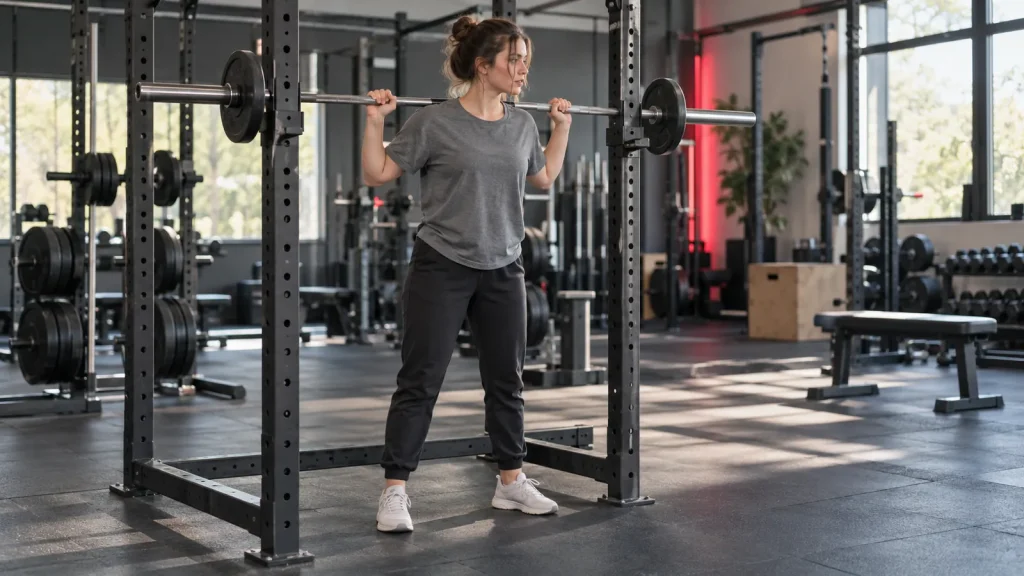
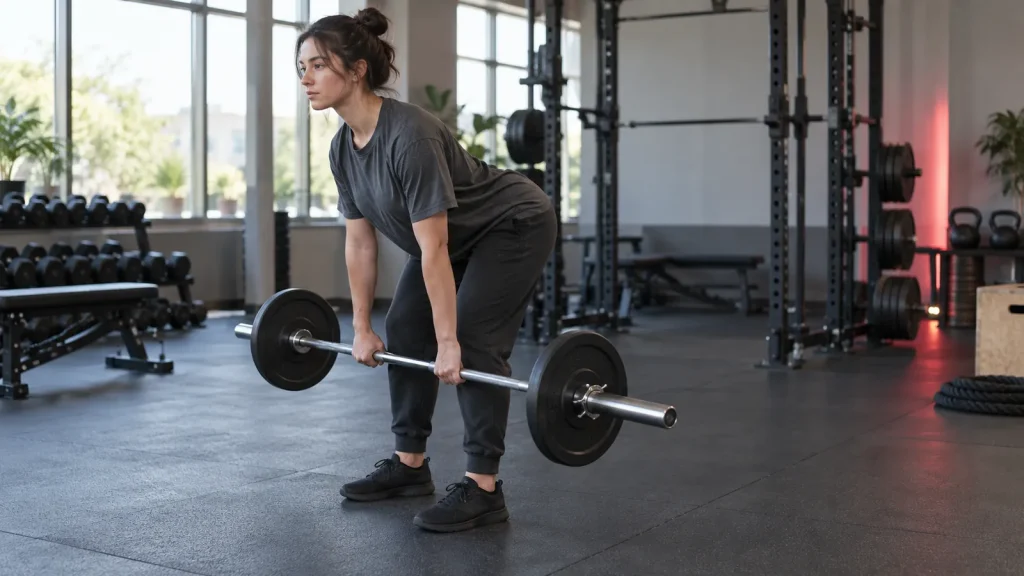
This is Symmetric Strength's own beginner full-body plan. You train three non-consecutive days a week and alternate two workouts, A and B. Workout A is back squat, bench press and barbell row. Workout B is deadlift, overhead press, lat pulldown and Romanian deadlift. Week one runs A, B, A and week two runs B, A, B.
Each lift has a set and rep target: three sets of eight on squat, bench press and overhead press, three of ten on rows and Romanian deadlifts, and three of five on deadlifts. You pick a weight you can lift cleanly for every rep, write it down and try to add a little at the next workout. Writing numbers down is what turns the gym into a plan.
The structure follows what the American College of Sports Medicine reported in its 2026 position stand: at least two sessions a week improves strength, and two to three sets per exercise covers most of the benefit for strength. Three sessions give you room to practice each lift often without any single day running too long.
The plan works every major pattern each week: squat, hip hinge, horizontal push, vertical push, horizontal pull and vertical pull. That balance matches how Symmetric Strength scores lifters, so your numbers show up evenly on your strength profile instead of leaving one pattern behind.
The schedule
Train on Monday, Wednesday, Friday, or any other days with rest between. Every set uses the same weight, the one you can lift for the written reps.
Workout A
| Lift | Sets and reps |
|---|---|
| Back squat | 3 x 8 |
| Bench press | 3 x 8 |
| Barbell row | 3 x 10 |
Workout B
| Lift | Sets and reps |
|---|---|
| Deadlift | 3 x 5 |
| Overhead press | 3 x 8 |
| Lat pulldown | 3 x 8 |
| Romanian deadlift | 3 x 10 |
Week pattern: A-B-A / B-A-B, repeating.
Progression and stall rules
Add weight after a clean session
If you finished every rep of every set on a lift with good form and could have done a rep or two more, add the small jump next time: 5 lb (2.5 kg) on squat, deadlift, Romanian deadlift and lat pulldown, 2.5 lb (1.25 kg) on bench press, barbell row and overhead press. This progression rule is our own design for this plan.
Repeat the weight after a miss
If a set fell short of its reps, or the last reps were grinding with form slipping, repeat the same weight at the next workout. Repeating a weight is normal.
Deload after three misses
If you repeat a weight three times without finishing the sets, take about 10% off and build back up. Check sleep, food and rest between sets before you blame the plan.
Start light on the hinges
Deadlift and Romanian deadlift take the most practice. Use a weight that feels easy for the first two weeks while you learn the hip hinge, then start adding. The pulldown follows the same rule as every other lift.
Weekly volume
Work sets per lift, counted from the schedule above (warm-ups not included).
| Lift | Week 1 | Week 2 |
|---|---|---|
| Back squat | 6 | 3 |
| Bench press | 6 | 3 |
| Barbell row | 6 | 3 |
| Deadlift | 3 | 6 |
| Overhead press | 3 | 6 |
| Lat pulldown | 3 | 6 |
| Romanian deadlift | 3 | 6 |
Who it suits
A good fit
- Women who are new to lifting or returning after a long break and want a written plan with weights to follow.
- Anyone who trains in a gym with a barbell, a rack, a bench and a lat pulldown machine, and can give about an hour three times a week.
- Lifters who want to get stronger on the big lifts and see their score rise, with no pressure to change how they look.
Look elsewhere if
- People who cannot reach a barbell gym. Start with a machine or dumbbell routine and come back.
- Anyone with an injury, a health condition, or who is pregnant or postpartum. Check with your doctor or physical therapist before choosing exercises, and ask them to adapt the lifts that do not suit you.
- Lifters who want a shorter session. Workout A has three exercises and Workout B has four, so most sessions fit in under an hour. If you have less time, keep the first two lifts of the day and add the rest back later.
Common mistakes
Starting too heavy
Begin with weights you could lift for about ten reps on the first day, then add from there. The first weeks are for learning the movements. A light start leaves months of room to progress.
Staying with light weights forever
Light dumbbells are fine on day one, but strength comes from adding load over time. The ACSM review found a clear dose-response for strength: heavier loads, around 80 percent of your one-rep max and above, gave larger strength gains. You do not need that on week one. Work toward it.
Adding weight after a grind
Add weight only after you finish every rep with good form. Add the small jump, not a big one. Slow and steady beats a jump you cannot hold.
Skipping the pulling lifts
Rows and pulldowns balance the pressing and keep your score even. If the pulldown feels awkward at first, use a light weight and a slow pace, and keep it in the plan.
Cutting rest short
Rest two to three minutes between the heavy sets on the main lifts, and one to two minutes between the lighter ones. Rushed rest is the most common reason the last set falls apart.
Never testing your numbers
Log every session, then check your lifts against the standards. Seeing a score move is the best way to stay with a plan for months.
Your sample week
For each lift, enter: Weight you use for your sets today. The weights below update as you type. Your numbers stay in your browser and are not saved. The numbers shown are an example lifter.
Workout A
| Set | Reps | Weight (lb) |
|---|---|---|
| 1 | 8 | 65 |
| 2 | 8 | 65 |
| 3 | 8 | 65 |
| Set | Reps | Weight (lb) |
|---|---|---|
| 1 | 8 | 45 |
| 2 | 8 | 45 |
| 3 | 8 | 45 |
| Set | Reps | Weight (lb) |
|---|---|---|
| 1 | 10 | 55 |
| 2 | 10 | 55 |
| 3 | 10 | 55 |
Workout B
| Set | Reps | Weight (lb) |
|---|---|---|
| 1 | 5 | 85 |
| 2 | 5 | 85 |
| 3 | 5 | 85 |
| Set | Reps | Weight (lb) |
|---|---|---|
| 1 | 8 | 35 |
| 2 | 8 | 35 |
| 3 | 8 | 35 |
| Set | Reps | Weight (lb) |
|---|---|---|
| 1 | 8 | 55 |
| 2 | 8 | 55 |
| 3 | 8 | 55 |
| Set | Reps | Weight (lb) |
|---|---|---|
| 1 | 10 | 65 |
| 2 | 10 | 65 |
| 3 | 10 | 65 |
The spreadsheet
The file has three sheets: your numbers, the full week with every weight as a formula, and a progress table that carries the weights forward. It opens in Excel, Numbers and LibreOffice. The weights in the link below use the numbers you typed above.
Open it in Google Sheets
- Download the .xlsx file above.
- Go to Google Drive and choose New, then File upload, and pick the file.
- Double-click the uploaded file and choose Open with Google Sheets.
- Choose File, then Save as Google Sheets so you can edit it.
Want the weights to follow you into the gym? Create a free account and the program loads into Train for you.
How it compares
Strength training program for women vs StrongLifts 5x5
StrongLifts is the simpler of the two: five lifts, five sets of five, and one pass or fail rule. This plan has more variety, with rows, a pulldown and a Romanian deadlift built in, so it takes longer per session. Read the StrongLifts 5x5 guide.
Strength training program for women vs Starting Strength
Starting Strength is a barbell-only novice plan that adds weight every session on very few lifts. This plan spreads effort across more movements and uses smaller jumps, which suits lifters who want balanced progress on every pattern. Read the Starting Strength guide.
Strength training program for women vs Upper/Lower Split
A good next step once your weights stall. An upper and lower split gives each muscle group more weekly work across four days instead of three full-body sessions. Read the Upper/Lower Split guide.
Load Strength training program for women into Train and log each session against the plan.
Start it in Symmetric StrengthCommon questions
Will lifting weights make me bulky?
No, not by accident. Women do build muscle, but the process is slow and takes years of training and eating for it on purpose. A meta-analysis summarised by Strengthlog found an average of about 1.5 kg (3.2 lb) of lean mass gained over 15 weeks, alongside strength gains of 25 percent or more. Research summarised by Stronger By Science also reports that relative gains in muscle are similar between women and men, even though men gain more in absolute terms because they start with more muscle.
How heavy should I start?
Start with a weight you could lift for about ten reps with clean form, then use the first week or two to find a weight where the last rep of each set is hard but still good. That is our coaching rule rather than a published figure. Do not copy someone else's starting numbers.
How often should I train?
Three days a week, with a rest day between workouts. The ACSM 2026 position stand reports that at least two sessions a week improves strength, so a busy week with two sessions still counts. Do the A and B workouts in order and pick up where you left off.
Do I need to do cardio as well?
Not for this plan to work. Many women like to add walking, cycling or other cardio for heart health and enjoyment, which is a fine choice. Keep it easy enough that it does not take away from your lifting sessions, and avoid leg-heavy cardio the day before squats or deadlifts.
Do women need a different program from men?
No. Stronger By Science concludes there is no evidence that women need fundamentally different programs, because the differences between the sexes in response are minor and training should follow goals and experience. The loads change because your strength is different, and the plan lets you set that yourself.
How long should I follow this plan?
Until your weights stop going up on most lifts. For many new lifters that takes several months. When you start to stall on most lifts, move to a plan with more weekly structure, such as an upper and lower split.
Why a lat pulldown instead of pull-ups?
A pulldown lets you set the load in small steps, so you can add weight every few sessions from day one. Pull-ups ask for a lot of strength before you can do a single rep. Once you can pull your own bodyweight for sets of eight, you can swap them in.
Know where you stand
Before you start, check how your lifts compare on the strength standards, estimate a max with the one-rep max calculator, or score your total with the DOTS calculator.
Sources and credit
This is Symmetric Strength's own program, built on the Beginner Full Body Workout A and Workout B in the Symmetric Strength app. The exercise science comes from the sources listed; the progression rules and starting advice are our own coaching design.
- ACSM Position Stand: Resistance Training Prescription for Muscle Function, Hypertrophy, and Physical Performance in Healthy Adults, 2026 (Medicine & Science in Sports & Exercise, PubMed Central)
- Sex differences in muscle and strength (Stronger By Science)
- 6 strength training myths women still hear (Strengthlog)
Checked . Symmetric Strength is not affiliated with Symmetric Strength. Program names are used only to identify the programs.