Upper/lower split guide and free spreadsheet
Intermediate · 4 days a week · 8 to 12 weeks, then reassess · Strength and size, each muscle twice a week
A four-day week that trains every major muscle twice, with heavy compounds first and accessories after, for lifters ready to leave full-body beginner plans.
Free. The spreadsheet needs no account.
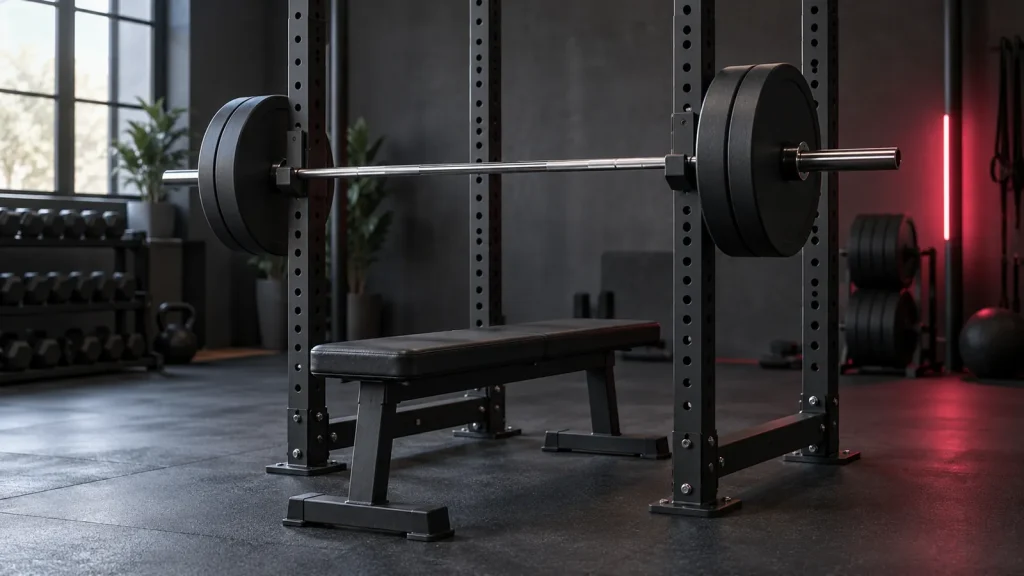
How Upper/lower split works
An upper/lower split divides the week into upper-body days (chest, back, shoulders, arms) and lower-body days (quads, hamstrings, glutes, calves). With four training days you do two of each, so every muscle gets worked twice a week.
A common week alternates the two types with rest days between: Monday Upper A, Tuesday Lower A, Thursday Upper B, Friday Lower B. The A and B days use different exercises, so each muscle is hit from a few angles. Our in-app templates are named Upper A (push focus), Lower A (squat focus), Upper B (pull focus) and Lower B (deadlift focus).
This guide lists the main barbell lifts of each day with the sets and reps from the in-app template. The template also holds accessories such as incline dumbbell press, lat pulldown, lateral raises, curls, leg press and calf raises. Those stay out of the sample-week calculator because you pick their weight by feel. Chin-ups on Upper B are bodyweight, so they have no weight box.
Sets and reps are a template, not a law. The PureGym example uses 3 sets of 10 to 12 on compounds. The Weightology example also works in sets of 10 to 12 but sets each one at a stated effort level, so you stop at a target effort rather than a target weight. Our template puts the first lift of each day lower, at 5 to 8 reps, to lean toward strength. Pick a style that fits your goal and keep it for several weeks.

The schedule
Train on Monday, Tuesday, Thursday, Friday, or any other days with rest between. Every set uses the same weight, the one you can lift for the written reps.
Upper A (push focus)
| Lift | Sets and reps |
|---|---|
| Bench press | 4 x 6 |
| Barbell row | 4 x 8 |
Lower A (squat focus)
| Lift | Sets and reps |
|---|---|
| Squat | 4 x 6 |
| Romanian deadlift | 3 x 10 |
Upper B (pull focus)
| Lift | Sets and reps |
|---|---|
| Overhead press | 4 x 6 |
Lower B (deadlift focus)
| Lift | Sets and reps |
|---|---|
| Deadlift | 3 x 5 |
| Front squat | 3 x 8 |
Progression and stall rules
Progress once the reps are clean
When you finish every prescribed set and rep with good form, add the smallest jump you have at the next session of that lift. The sources describe progressive overload as more weight, reps or sets, or a harder variation, but give no fixed jump. These jumps are our own defaults.
Repeat the weight after a miss
If you miss reps, keep the same weight at the next session of that lift. One miss is normal.
Deload after repeated misses
If the same lift stalls for three sessions in a row, take about 10% off the bar and build back up. This deload is our own default, not from the sources.
Keep a gap between similar sessions
The sources recommend at least 48 hours between sessions that train the same muscles, and at least one full rest day a week. The Monday, Tuesday, Thursday, Friday week does this.
Reassess after 8 to 12 weeks
One source suggests running a plan for 8 to 12 weeks before reviewing it. Swap accessories, or move to a program with more structure, when progress slows on most lifts.
Weekly volume
Work sets per lift, counted from the schedule above (warm-ups not included).
| Lift | Sets per week |
|---|---|
| Bench press | 4 |
| Barbell row | 4 |
| Squat | 4 |
| Romanian deadlift | 3 |
| Overhead press | 4 |
| Deadlift | 3 |
| Front squat | 3 |
Who it suits
A good fit
- Lifters who have finished a beginner linear program and want more weekly volume.
- Anyone who can train four days a week and wants each muscle twice.
- People who like shorter sessions, since each day covers half the body.
Look elsewhere if
- Brand-new lifters who can still add weight every session on a full-body plan. Stay there first.
- Anyone who can only train two or three days a week. A full-body plan fits better.
- Lifters who want a fixed ladder of percentages. This is a flexible template without one.
Common mistakes
Same lifts, same intensity, every day
One source warns that hitting the same muscles at the same weight and intensity every session can lead to overtraining. Make the A and B days differ in exercise choice and in difficulty.
Skipping the warm-up
Climb through progressively heavier warm-up sets before the first working set. Never open with your heaviest weight cold.
Stacking similar days
Two upper or two lower days back to back remove the recovery gap that makes the split work. Alternate them.
Ignoring the small muscles
With two upper days, arms and side delts get little volume. One source notes smaller muscles can need extra frequency, so add a few sets of curls, pushdowns and raises.
Never progressing
A split builds strength only if load or reps rise over time. Log every session and try to beat the last.
Your sample week
For each lift, enter: Weight you use for your working sets. The weights below update as you type. Your numbers stay in your browser and are not saved. The numbers shown are an example lifter.
Upper A (push focus)
| Set | Reps | Weight (lb) |
|---|---|---|
| 1 | 6 | 135 |
| 2 | 6 | 135 |
| 3 | 6 | 135 |
| 4 | 6 | 135 |
| Set | Reps | Weight (lb) |
|---|---|---|
| 1 | 8 | 115 |
| 2 | 8 | 115 |
| 3 | 8 | 115 |
| 4 | 8 | 115 |
Lower A (squat focus)
| Set | Reps | Weight (lb) |
|---|---|---|
| 1 | 6 | 185 |
| 2 | 6 | 185 |
| 3 | 6 | 185 |
| 4 | 6 | 185 |
| Set | Reps | Weight (lb) |
|---|---|---|
| 1 | 10 | 135 |
| 2 | 10 | 135 |
| 3 | 10 | 135 |
Upper B (pull focus)
| Set | Reps | Weight (lb) |
|---|---|---|
| 1 | 6 | 85 |
| 2 | 6 | 85 |
| 3 | 6 | 85 |
| 4 | 6 | 85 |
Lower B (deadlift focus)
| Set | Reps | Weight (lb) |
|---|---|---|
| 1 | 5 | 225 |
| 2 | 5 | 225 |
| 3 | 5 | 225 |
| Set | Reps | Weight (lb) |
|---|---|---|
| 1 | 8 | 135 |
| 2 | 8 | 135 |
| 3 | 8 | 135 |
The spreadsheet
The file has three sheets: your numbers, the full week with every weight as a formula, and a progress table that carries the weights forward. It opens in Excel, Numbers and LibreOffice. The weights in the link below use the numbers you typed above.
Open it in Google Sheets
- Download the .xlsx file above.
- Go to Google Drive and choose New, then File upload, and pick the file.
- Double-click the uploaded file and choose Open with Google Sheets.
- Choose File, then Save as Google Sheets so you can edit it.
Want the weights to follow you into the gym? Create a free account and the program loads into Train for you.
How it compares
Upper/lower split vs Push/Pull/Legs
Both are muscle-group splits. Push/pull/legs uses three groups and needs six days to train each twice. Upper/lower does it in four. Read the Push/Pull/Legs guide.
Upper/lower split vs Starting Strength
Starting Strength is a full-body novice program that adds weight every session. Move to a split like this one once those jumps stop. Read the Starting Strength guide.
Load Upper/lower split into Train and log each session against the plan.
Start it in Symmetric StrengthThe workouts in Train are a simplified version of this program, with one rep count per lift. Use the schedule above for the exact sets.
Common questions
How many days a week do I need?
Four: two upper and two lower sessions. PureGym also gives 2-day and 3-day versions, and Weightology has 5-day and 6-day versions. Four is enough for most people.
How many sets per muscle per week?
The Weightology 4-day layout works out to about 12 sets per muscle per week, or 16 with one extra set on each exercise. Start in that range and add sets only once recovery is good.
What rep ranges should I use?
The sources use 3 sets of 10 to 12 on compounds and roughly 8 to 20 on accessories. Our template puts the first lift of each day lower, around 5 to 8 reps, and accessories at 10 to 15.
Can I do it on three days?
Yes. PureGym describes upper, lower, upper one week and lower, upper, lower the next. Each muscle then trains once or twice a week, so progress is slower.
How long should I run it?
PureGym suggests following one program for 8 to 12 weeks, then reassessing. Keep going while you are still adding weight. Change it if you stall on most lifts.
Is this better than push/pull/legs?
Neither wins outright. Upper/lower trains each muscle twice on four days. Push/pull/legs usually needs six days to do that.
Know where you stand
Before you start, check how your lifts compare on the strength standards, estimate a max with the one-rep max calculator, or score your total with the DOTS calculator.
Sources and credit
The upper/lower split is a common training structure with no single creator. This guide describes it in our own words, drawing on PureGym and Weightology. The in-app templates are our own.
- Upper/lower split: what it is and how to do it (PureGym)
- 4-6 day per week upper/lower hypertrophy split (Weightology)
Checked . Symmetric Strength is not affiliated with PureGym or Weightology. Program names are used only to identify the programs.