Dumbbell full body workout: 3-day plan and free spreadsheet
Beginner · 3 days a week · Until the heaviest dumbbells stop being enough · Whole body three days a week with dumbbells and a bench
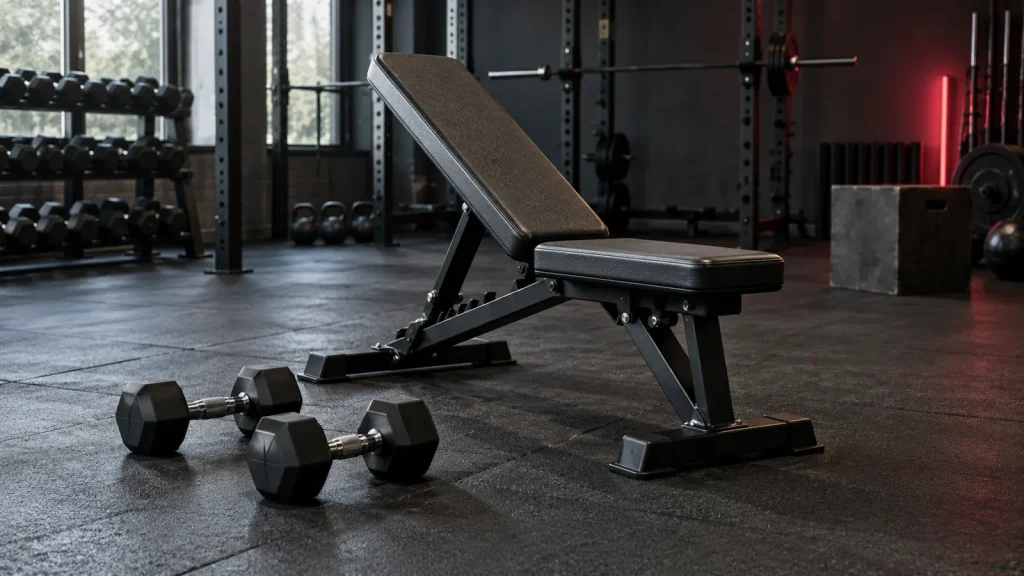
Three full body days a week with dumbbells and a bench, for beginners or anyone training at home who wants one clear plan to follow.
Free. The spreadsheet needs no account.
How Dumbbell full body workout works
This is our own program. Strengthlog and Liftosaur informed the progression rules, but their plans differ from this one: Strengthlog alternates two workouts of 3 sets of 10, and Liftosaur's is a push/pull/legs split. You train three non-consecutive days, such as Monday, Wednesday and Friday. Every session covers a squat or lunge pattern, a press and a row, plus a little shoulder and arm work.
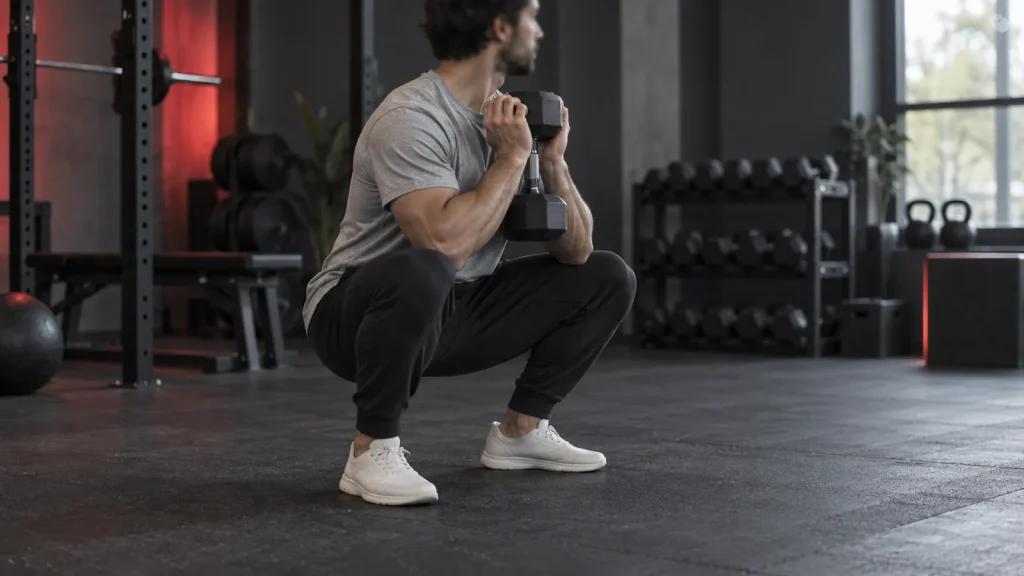
Day 1 is the base day: goblet squat, dumbbell bench press and dumbbell row for 3 sets of 10, then 2 sets of lateral raises and curls. Day 2 swaps in lunges, shoulder press and incline press, with rows moved up to 12 reps and rear delt flyes to finish. Day 3 repeats the squat, bench and row for 4 sets of 8 with heavier dumbbells, then flyes and hammer curls.
Our templates use about 90 seconds between big sets, 60 seconds between small ones, and 2 minutes for the goblet squat and bench press on Day 3, where the weights are heavier. A session should fit in under an hour. These rest times are ours, not from either source.
Pick a starting weight you can lift for the target reps with two or three reps to spare. Strengthlog says many beginners start with 5 to 15 lb dumbbells. The starting weights in the spreadsheet are placeholders for someone who already lifts, so type in what you use now and the sheet fills in the same weights across the week.
There is no hip hinge in the template. If you want one, add dumbbell Romanian deadlifts for 3 sets of 10 after your squat on Day 1 or Day 3. Strengthlog uses them in its own beginner plan. The sample week does not include them.
The schedule
Train on Monday, Wednesday, Friday, or any other days with rest between. Every set uses the same weight, the one you can lift for the written reps.
Day 1
| Lift | Sets and reps |
|---|---|
| Goblet squat | 3 x 10 |
| Dumbbell bench press | 3 x 10 |
| Dumbbell row | 3 x 10 |
| Lateral raise | 2 x 15 |
| Dumbbell curl | 2 x 12 |
Day 2
| Lift | Sets and reps |
|---|---|
| Lunge | 3 x 10 |
| Dumbbell shoulder press | 3 x 10 |
| Incline dumbbell press | 3 x 10 |
| Dumbbell row | 3 x 12 |
| Rear delt fly | 2 x 15 |
Day 3
| Lift | Sets and reps |
|---|---|
| Goblet squat | 4 x 8 |
| Dumbbell bench press | 4 x 8 |
| Dumbbell row | 4 x 8 |
| Dumbbell fly | 2 x 12 |
| Hammer curl | 2 x 12 |
Progression and stall rules
Reps first, then weight
Strengthlog and Liftosaur both use double progression: pick a weight you can lift for the target reps with control, add reps each session, and add weight only after you hit the top of the range on every set. Strengthlog's example starts at 20 lb with 8, 8, 8 and builds toward 3 sets of 10 before the weight goes up. Liftosaur caps its sets at 12 reps before adding weight. Our template ranges follow the same idea. The spreadsheet adds a fixed jump per session, so on days when you have not reached the top of the range, hold the weight.
Jump sizes
Liftosaur uses 5 lb on compound lifts and 2.5 lb on isolation lifts, and notes that 5 lb is too big a jump for small muscles like rear delts and biceps. We use the same jumps in the sheet. If your dumbbells only go up in bigger steps, add reps for longer, or add a pause at the bottom of each rep before you move up.
Stall rule
Liftosaur drops two increments and works back up when total reps on an exercise have not improved for 3 workouts in a row. Strengthlog says a workout one rep short of last time still counts, so log it and try again next session. Our default combines the two: after 3 flat sessions, drop about 10% and build back up, and never trade form for extra reps.
Missed reps are normal
Strengthlog says missing a rep goal is not failure. Keep the weight, note the reps, and try again.
When the dumbbells run out
Liftosaur says the goblet squat tends to stall first because you hit your heaviest dumbbell, and suggests moving to a single-leg squat such as the Bulgarian split squat. Liftosaur also notes that a single fixed pair will not work, so you need adjustable dumbbells or several pairs. Strengthlog suggests staying on a plan for at least 8 to 12 weeks and changing it once progress slows, which is when to consider a barbell program or a split.
Weekly volume
Work sets per lift, counted from the schedule above (warm-ups not included).
| Lift | Sets per week |
|---|---|
| Goblet squat | 7 |
| Dumbbell bench press | 7 |
| Dumbbell row | 10 |
| Lateral raise | 2 |
| Dumbbell curl | 2 |
| Lunge | 3 |
| Dumbbell shoulder press | 3 |
| Incline dumbbell press | 3 |
| Rear delt fly | 2 |
| Dumbbell fly | 2 |
| Hammer curl | 2 |
Who it suits
A good fit
- Beginners who train at home or in a small gym and want a plan built around dumbbells and a bench.
- Lifters coming back after a break who want three easy-to-recover days.
- Anyone who wants a dumbbell only workout plan that covers every major muscle each week without a split.
Look elsewhere if
- Lifters who can already squat and bench heavy with a barbell. A barbell program will scale further.
- Anyone with only one fixed pair of dumbbells. You need to be able to add weight over time.
- People who want to train one body part per day. This plan trains most muscles two or three times a week.
Common mistakes
Adding weight too early
Move up only when every set reaches the top of the rep range with control. Dumbbell jumps are big, and rushing them leads to ugly reps and stalled progress.
Skipping the warm-up set
Strengthlog suggests one light set of the first exercise before your working sets. It takes a minute and makes the first heavy set feel much better.
Letting the row get lazy
Brace one hand on the bench, keep your back flat and pull the dumbbell toward your hip, not up to your shoulder. A swinging torso takes the work away from your back.
Dropping the leg work
Goblet squats and lunges are the hardest part of the week and the easiest to skip. Keep them; they are half of the reason the plan covers your whole body.
Going to failure on every set
Stop a rep or two short on most sets. You are training three days a week and need to recover for the next one.
Not writing it down
Double progression only works if you know what you lifted last time. Log weight and reps for every set.
Your sample week
For each lift, enter: Dumbbell weight you use for your working sets. The weights below update as you type. Your numbers stay in your browser and are not saved. The numbers shown are an example lifter.
Day 1
| Set | Reps | Weight (lb) |
|---|---|---|
| 1 | 10 | 35 |
| 2 | 10 | 35 |
| 3 | 10 | 35 |
| Set | Reps | Weight (lb) |
|---|---|---|
| 1 | 10 | 25 |
| 2 | 10 | 25 |
| 3 | 10 | 25 |
| Set | Reps | Weight (lb) |
|---|---|---|
| 1 | 10 | 30 |
| 2 | 10 | 30 |
| 3 | 10 | 30 |
| Set | Reps | Weight (lb) |
|---|---|---|
| 1 | 15 | 10 |
| 2 | 15 | 10 |
| Set | Reps | Weight (lb) |
|---|---|---|
| 1 | 12 | 15 |
| 2 | 12 | 15 |
Day 2
| Set | Reps | Weight (lb) |
|---|---|---|
| 1 | 10 | 20 |
| 2 | 10 | 20 |
| 3 | 10 | 20 |
| Set | Reps | Weight (lb) |
|---|---|---|
| 1 | 10 | 20 |
| 2 | 10 | 20 |
| 3 | 10 | 20 |
| Set | Reps | Weight (lb) |
|---|---|---|
| 1 | 10 | 20 |
| 2 | 10 | 20 |
| 3 | 10 | 20 |
| Set | Reps | Weight (lb) |
|---|---|---|
| 1 | 12 | 30 |
| 2 | 12 | 30 |
| 3 | 12 | 30 |
| Set | Reps | Weight (lb) |
|---|---|---|
| 1 | 15 | 10 |
| 2 | 15 | 10 |
Day 3
| Set | Reps | Weight (lb) |
|---|---|---|
| 1 | 8 | 35 |
| 2 | 8 | 35 |
| 3 | 8 | 35 |
| 4 | 8 | 35 |
| Set | Reps | Weight (lb) |
|---|---|---|
| 1 | 8 | 25 |
| 2 | 8 | 25 |
| 3 | 8 | 25 |
| 4 | 8 | 25 |
| Set | Reps | Weight (lb) |
|---|---|---|
| 1 | 8 | 30 |
| 2 | 8 | 30 |
| 3 | 8 | 30 |
| 4 | 8 | 30 |
| Set | Reps | Weight (lb) |
|---|---|---|
| 1 | 12 | 15 |
| 2 | 12 | 15 |
| Set | Reps | Weight (lb) |
|---|---|---|
| 1 | 12 | 15 |
| 2 | 12 | 15 |
The spreadsheet
The file has three sheets: your numbers, the full week with every weight as a formula, and a progress table that carries the weights forward. It opens in Excel, Numbers and LibreOffice. The weights in the link below use the numbers you typed above.
Open it in Google Sheets
- Download the .xlsx file above.
- Go to Google Drive and choose New, then File upload, and pick the file.
- Double-click the uploaded file and choose Open with Google Sheets.
- Choose File, then Save as Google Sheets so you can edit it.
Want the weights to follow you into the gym? Create a free account and the program loads into Train for you.
How it compares
Dumbbell full body workout vs StrongLifts 5x5
Also three full body days a week, but built on a barbell and adds weight every session. Choose it once you have a barbell and rack. Read the StrongLifts 5x5 guide.
Dumbbell full body workout vs Full body workout routine
Our barbell full-body plan for lifters who have outgrown beginner jumps, with heavy, medium and volume days. Pick it when you have a barbell and can no longer add dumbbell weight; pick this plan for home training with dumbbells. Read the Full body workout routine guide.
Dumbbell full body workout vs Starting Strength
A barbell full body plan with fewer exercises and heavier loads. This dumbbell plan is gentler and needs no rack. Read the Starting Strength guide.
Load Dumbbell full body workout into Train and log each session against the plan.
Start it in Symmetric StrengthCommon questions
What is a good dumbbell full body workout?
One that covers a squat or lunge, a press, a row and some shoulder and arm work, three times a week. That is what this plan does, with a bench and a few pairs of dumbbells.
Can I follow a dumbbell only workout plan without a bench?
Yes. Strengthlog says to do the floor press if you do not have a bench, so do the same for the bench press here. Incline press has no floor version, so our suggestion is to drop it and add a set to the floor press.
How heavy should the dumbbells be?
Heavy enough that the last rep of each set is hard but your form stays clean. Strengthlog says many beginners start with 5 to 15 lb dumbbells. If you cannot finish the reps, go lighter.
How often should I add weight?
When you reach the top of the rep range on every set, move up one step on the next session. For small muscles such as rear delts and biceps, use the smallest step you have.
Is this enough to build muscle?
For a beginner, yes. Training most muscles two or three times a week with progressive overload is a solid start. Strengthlog suggests staying on a plan for at least 8 to 12 weeks and changing it when progress slows, so plan a review then.
How long should I run it?
Until you stop being able to add reps or weight even after a lighter week, or until you run out of dumbbell weight. Then move to a barbell program or a split.
Do the in-app days match this page?
Yes. Start-it loads the three Dumbbell Full Body days with the same sets and reps shown here.
Know where you stand
Before you start, check how your lifts compare on the strength standards, estimate a max with the one-rep max calculator, or score your total with the DOTS calculator.
Sources and credit
This is Symmetric Strength's own program. The progression rules draw on the double progression described by Strengthlog and Liftosaur, written here in our own words. Symmetric Strength is not affiliated with either.
- Beginner dumbbell program (Strengthlog)
- Dumbbell push/pull/legs program with double progression (Liftosaur)
Checked . Symmetric Strength is not affiliated with Strengthlog or Liftosaur. Program names are used only to identify the programs.