Calisthenics workout plan for beginners: 3-day bodyweight program
Beginner · 3 days a week · Until the harder steps stall · Full-body bodyweight strength: pull, push, squat and hinge in three pairs
A free three-day, full-body calisthenics workout plan for beginners: pull, push, squat and hinge in three pairs, with a ladder of harder steps for each. To start you need a pull-up bar, bars to dip on and a low bar or table for rows.
Free. The spreadsheet needs no account.
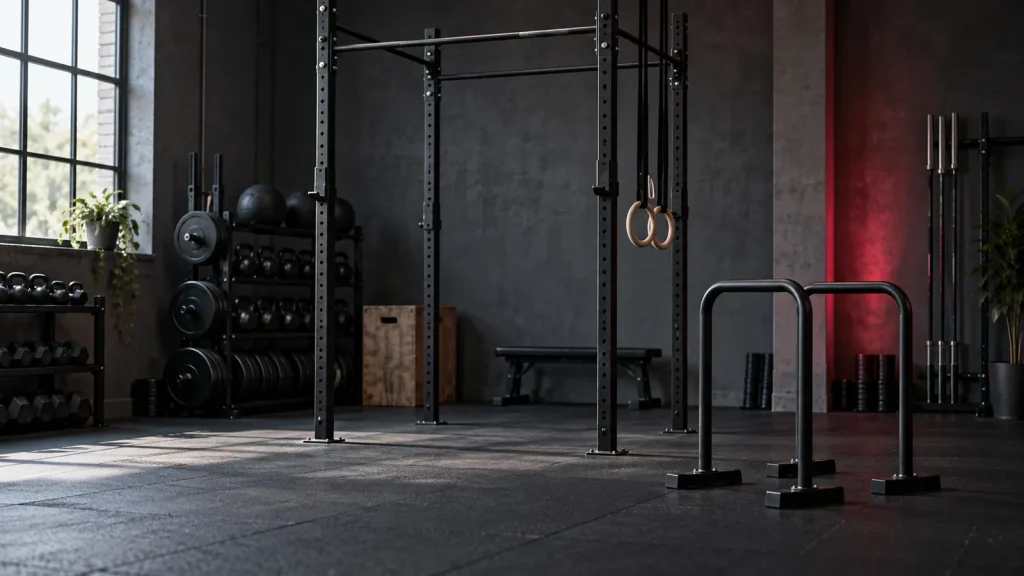
How Calisthenics program (bodyweight strength) works
This guide is built on the Recommended Routine from the r/bodyweightfitness community. It is three full-body sessions a week on non-consecutive days, for example Monday, Wednesday and Friday. Every session is the same workout. Sessions run about 45 to 60 minutes depending on the version.
Each session starts with a warm-up and some skill work. Antranik's summary lists dynamic stretches and five bodyline drills for the warm-up, then support holds, a wall handstand and skin the cat if you have rings. Boostcamp's version lists a band shoulder warm-up, squat sky reaches, wrist prep, dead bugs, arch hangs and a support hold. The sources differ, so use any short warm-up that loosens shoulders, wrists, hips and spine.
The strength block is three pairs of exercises, each done for 3 sets, alternating the two exercises in a pair. Liftosaur and Boostcamp pair a pull-up ladder with a squat ladder, a dip ladder with a hinge ladder (a Romanian deadlift, then single-leg and Nordic curl versions), and rows with push-ups. Antranik pairs pull-ups with dips and lists an L-sit ladder alongside squats. Our reading is that the pairing matters less than covering every pattern. Liftosaur adds a short core block at the end: a plank, ab rollouts, a Pallof press and a reverse hyperextension.
Each movement has a ladder of steps. Liftosaur's version of the pull-up ladder runs scapular pull-up, arch hang, negative pull-up, pull-up. Its push-up ladder runs wall, incline, floor, diamond, pseudo planche. Its row ladder runs vertical, incline, inverted, wide. Its squat ladder runs assisted squat, bodyweight squat, split squat, Bulgarian split squat, shrimp squat. You sit on the step that gives you 5 to 8 clean reps.
Our in-app days are a simplified version. Each lists one step of each pair at 3 sets of 5, using pull-up, bodyweight squat, dip, back extension, inverted row and push-up, then ab wheel rollouts on Days 1 and 3 and hanging leg raises on Day 2. Back extensions stand in for the hinge pattern. The warm-up, skill work and easier or harder steps are not in the app, so use this guide to choose your step and swap the exercise when you move up. The hinge slot needs a back extension station, and the core slot needs an ab wheel or a bar to hang from, so use a floor version if you have neither.
The spreadsheet tracks added weight only. Calisthenics starts at bodyweight, so every cell starts at 0. It becomes useful once you reach the top of a ladder and begin adding weight with a belt or vest.

The schedule
Train on Monday, Wednesday, Friday, or any other days with rest between. Every set uses the same weight, the one you can lift for the written reps.
Day 1
| Lift | Sets and reps |
|---|---|
| Pull-up (or your current step) | 3 x 5 |
| Bodyweight squat (or your current step) | 3 x 5 |
| Dip (or your current step) | 3 x 5 |
| Back extension (hinge slot) | 3 x 5 |
| Inverted row (or your current step) | 3 x 5 |
| Push-up (or your current step) | 3 x 5 |
Day 2
| Lift | Sets and reps |
|---|---|
| Pull-up (or your current step) | 3 x 5 |
| Bodyweight squat (or your current step) | 3 x 5 |
| Dip (or your current step) | 3 x 5 |
| Back extension (hinge slot) | 3 x 5 |
| Inverted row (or your current step) | 3 x 5 |
| Push-up (or your current step) | 3 x 5 |
Day 3
| Lift | Sets and reps |
|---|---|
| Pull-up (or your current step) | 3 x 5 |
| Bodyweight squat (or your current step) | 3 x 5 |
| Dip (or your current step) | 3 x 5 |
| Back extension (hinge slot) | 3 x 5 |
| Inverted row (or your current step) | 3 x 5 |
| Push-up (or your current step) | 3 x 5 |
Progression and stall rules
Pick a step you can do for 5 to 8 reps
For each movement, choose the hardest step where you can finish 3 sets of 5 reps with clean form but could not manage much more than 8. The routine's own advice is the same: find the version you can do for 3 sets in that range.
Add a rep, then move up a step
Our rule: add one rep per set each session, from 5 up to 8. When all three sets hit 8, move to the next step on the ladder and drop back to 3 sets of 5. Liftosaur's version of the routine uses the same one-rep-a-session idea; the community routine itself only says to level up once you reach the top reps.
Held positions go by seconds
Holds such as a support hold or plank are timed. Liftosaur adds 5 seconds a session and moves on at 30 seconds, or 60 seconds for the dip support hold. Treat those numbers as a starting point, not a law.
Added weight is for the top of the ladder
Once you are on the last step of a ladder and have hit 3 x 8, add weight with a belt, vest or backpack. Liftosaur suggests about 5 lb (2.5 kg) for upper-body pairs and 10 lb (5 kg) for squats and hinges. The sheet uses those jumps. Leave every cell at 0 until you get there.
Rest and stalls
Liftosaur lists 90 seconds between the pair exercises, 60 seconds between core exercises, and up to 3 minutes if reps fall off sharply. After a miss, Liftosaur repeats the same numbers next session and prescribes no deload. Our own rule goes further: if you miss reps three sessions in a row, drop to the previous step or take about 10% off any added weight.
Skip a pull-up or dip step until the base is there
Antranik's summary of the routine says to skip the pull-up ladder if you cannot yet do 3 x 8 horizontal rows, and to skip the dip ladder if you cannot do 3 x 8 diamond push-ups. Start on the easier steps instead.
Weekly volume
Work sets per lift, counted from the schedule above (warm-ups not included).
| Lift | Sets per week |
|---|---|
| Pull-up (or your current step) | 9 |
| Bodyweight squat (or your current step) | 9 |
| Dip (or your current step) | 9 |
| Back extension (hinge slot) | 9 |
| Inverted row (or your current step) | 9 |
| Push-up (or your current step) | 9 |
Who it suits
A good fit
- Beginners who want a calisthenics routine with a clear weekly plan rather than a random list of exercises.
- People training at home or in a park who have, or can get, a pull-up bar and something to dip on.
- Lifters who want a bodyweight block with a push, pull, squat and hinge in every session.
Look elsewhere if
- Anyone who wants to build maximum muscle quickly. Bodyweight steps are hard to load in small increments, and a barbell or dumbbell plan makes that easier.
- People who want skills such as handstand push-ups or a planche as the main goal. This routine builds the base, with only a little skill work.
- Lifters who cannot yet hold a decent push-up or row. Start on the easiest steps of the ladders and expect it to feel slow at first.
Common mistakes
Starting on a step that is too hard
A 5-rep set of a step you cannot control is not progress. If your form breaks down before rep 5, drop to the previous step. Quality reps are what carry you up the ladder.
Skipping the easier pulling and pushing steps
Pull-ups and dips load the shoulders and elbows hard. If you cannot yet row or push-up well, build that first. Jumping straight to the harder step is the fastest route to sore elbows.
Moving up a step too early
Move on when you can do 3 sets of 8, not when one set feels easy. Hitting the top reps first gives you a margin on the new step.
Ignoring the hinge and core work
Pull-ups, dips and push-ups are the fun part. The squat, hinge and core slots balance the week and protect your lower back and shoulders.
Not tracking reps
With no plates to add, the log is your progression. Write down the step, sets and reps every session so you know when to move up.
Your sample week
For each lift, enter: Weight added on top of your bodyweight. The weights below update as you type. Your numbers stay in your browser and are not saved. The numbers shown are an example lifter.
Day 1
| Set | Reps | Weight (lb) |
|---|---|---|
| 1 | 5 | 0 |
| 2 | 5 | 0 |
| 3 | 5 | 0 |
| Set | Reps | Weight (lb) |
|---|---|---|
| 1 | 5 | 0 |
| 2 | 5 | 0 |
| 3 | 5 | 0 |
| Set | Reps | Weight (lb) |
|---|---|---|
| 1 | 5 | 0 |
| 2 | 5 | 0 |
| 3 | 5 | 0 |
| Set | Reps | Weight (lb) |
|---|---|---|
| 1 | 5 | 0 |
| 2 | 5 | 0 |
| 3 | 5 | 0 |
| Set | Reps | Weight (lb) |
|---|---|---|
| 1 | 5 | 0 |
| 2 | 5 | 0 |
| 3 | 5 | 0 |
| Set | Reps | Weight (lb) |
|---|---|---|
| 1 | 5 | 0 |
| 2 | 5 | 0 |
| 3 | 5 | 0 |
Day 2
| Set | Reps | Weight (lb) |
|---|---|---|
| 1 | 5 | 0 |
| 2 | 5 | 0 |
| 3 | 5 | 0 |
| Set | Reps | Weight (lb) |
|---|---|---|
| 1 | 5 | 0 |
| 2 | 5 | 0 |
| 3 | 5 | 0 |
| Set | Reps | Weight (lb) |
|---|---|---|
| 1 | 5 | 0 |
| 2 | 5 | 0 |
| 3 | 5 | 0 |
| Set | Reps | Weight (lb) |
|---|---|---|
| 1 | 5 | 0 |
| 2 | 5 | 0 |
| 3 | 5 | 0 |
| Set | Reps | Weight (lb) |
|---|---|---|
| 1 | 5 | 0 |
| 2 | 5 | 0 |
| 3 | 5 | 0 |
| Set | Reps | Weight (lb) |
|---|---|---|
| 1 | 5 | 0 |
| 2 | 5 | 0 |
| 3 | 5 | 0 |
Day 3
| Set | Reps | Weight (lb) |
|---|---|---|
| 1 | 5 | 0 |
| 2 | 5 | 0 |
| 3 | 5 | 0 |
| Set | Reps | Weight (lb) |
|---|---|---|
| 1 | 5 | 0 |
| 2 | 5 | 0 |
| 3 | 5 | 0 |
| Set | Reps | Weight (lb) |
|---|---|---|
| 1 | 5 | 0 |
| 2 | 5 | 0 |
| 3 | 5 | 0 |
| Set | Reps | Weight (lb) |
|---|---|---|
| 1 | 5 | 0 |
| 2 | 5 | 0 |
| 3 | 5 | 0 |
| Set | Reps | Weight (lb) |
|---|---|---|
| 1 | 5 | 0 |
| 2 | 5 | 0 |
| 3 | 5 | 0 |
| Set | Reps | Weight (lb) |
|---|---|---|
| 1 | 5 | 0 |
| 2 | 5 | 0 |
| 3 | 5 | 0 |
The spreadsheet
The file has three sheets: your numbers, the full week with every weight as a formula, and a progress table that carries the weights forward. It opens in Excel, Numbers and LibreOffice. The weights in the link below use the numbers you typed above.
Open it in Google Sheets
- Download the .xlsx file above.
- Go to Google Drive and choose New, then File upload, and pick the file.
- Double-click the uploaded file and choose Open with Google Sheets.
- Choose File, then Save as Google Sheets so you can edit it.
Want the weights to follow you into the gym? Create a free account and the program loads into Train for you.
How it compares
Calisthenics program (bodyweight strength) vs StrongLifts 5x5
Also three days a week and aimed at beginners, but it adds barbell weight every session. This routine climbs bodyweight steps instead. Read the StrongLifts 5x5 guide.
Calisthenics program (bodyweight strength) vs Greyskull LP
A beginner linear program on a barbell. Choose it if you have a gym and want to add weight to the bar each workout. Choose the bodyweight routine if you train with no equipment. Read the Greyskull LP guide.
Calisthenics program (bodyweight strength) vs Dumbbell full body workout
Also three full-body days, but weighted: dumbbells and a bench, with reps and then weight going up. Pick it if you have dumbbells and want to load the lifts; pick the bodyweight routine if you would rather climb progressions. Read the Dumbbell full body workout guide.
Load Calisthenics program (bodyweight strength) into Train and log each session against the plan.
Start it in Symmetric StrengthEach in-app day lists one step of each progression at 3 sets of 5, plus a core exercise. The easier and harder steps, the warm-up and the skill work are in this guide, so swap the step as you progress.
Common questions
Is this a good calisthenics workout plan for beginners?
Yes, if you can find a step you can do for 5 reps in each ladder. The community built the Recommended Routine as a free full-body starting point. The ladders let you start easy and move up.
How many days a week is the routine?
Three full-body days on non-consecutive days, such as Monday, Wednesday and Friday. Boostcamp describes at least one rest day between sessions.
What equipment do I need?
A pull-up bar, parallel bars or two sturdy surfaces for dips, and a low bar or table for rows. Rings, a resistance band and an ab wheel are used in some versions but not required to start.
How do I progress without weights?
Add reps first, then move to a harder step of the same movement. When you reach the last step and 3 sets of 8, add weight with a belt, vest or backpack.
Can I do it with the app?
Yes. The in-app Calisthenics Foundations days list one step per pair. Swap the exercise as you move up the ladders, since the app does not hold every step.
How long should I run it?
Boostcamp lists the routine as a 12-week program. Ours has no fixed end, so keep going while you climb the ladders. When most of your pairs have stalled for a few weeks, review your steps, sleep and food, and consider a different program.
Know where you stand
Before you start, check how your lifts compare on the strength standards, estimate a max with the one-rep max calculator, or score your total with the DOTS calculator.
Sources and credit
This guide is based on the Recommended Routine from the r/bodyweightfitness community on Reddit. We describe it in our own words from the Boostcamp, Liftosaur and Antranik write-ups. The progression rules are labelled as ours where they go beyond those sources. The in-app templates are our own simplified version.
- Recommended Routine overview (Boostcamp)
- r/bodyweightfitness Recommended Routine with progression ladders (Liftosaur)
- Recommended Routine summary (Antranik Kizirian)
Checked . Symmetric Strength is not affiliated with r/bodyweightfitness, Reddit, Boostcamp, Liftosaur or Antranik. Program names are used only to identify the programs.