Greyskull LP guide and free spreadsheet
Beginner · 3 days a week · Until you stall · Full-body linear strength with a final rep-out set
A three-day full-body plan for new lifters: small weight jumps, and one hard final set that tells you how fast to climb.
Free. The spreadsheet needs no account.
How Greyskull LP works
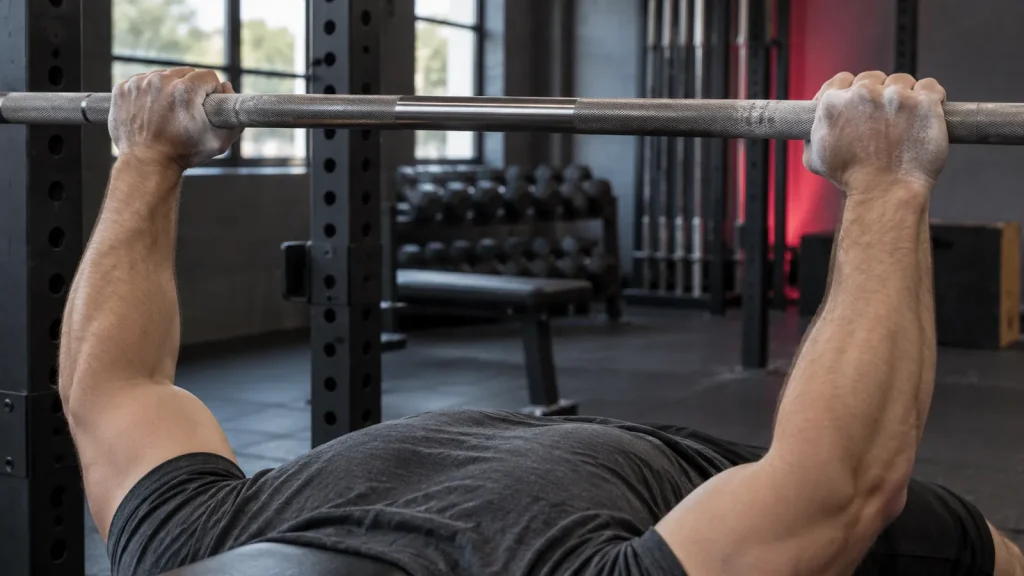
Greyskull LP alternates two full-body workouts on three non-consecutive days a week. In the version loaded in Train, Workout A is bench press and squat, and Workout B is overhead press and deadlift. Each lift is two sets of five, then a final set of five or more.
That last set is the 5+ set. Five reps is the minimum. Keep going for as many clean reps as you can, stopping a rep or two short of failure. The extra reps show whether the weight is too easy, about right, or too heavy.
Weight goes up a little every session you hit the minimum. When you miss, take about 10% off that one lift and build back up. The deadlift gets a single 5+ set because it costs so much recovery.
Write-ups of Greyskull LP differ on which lifts go on which day and whether chin-ups or rows are added. This page gives the core structure. John Sheaffer's book has the full details, options and assistance work.
The schedule
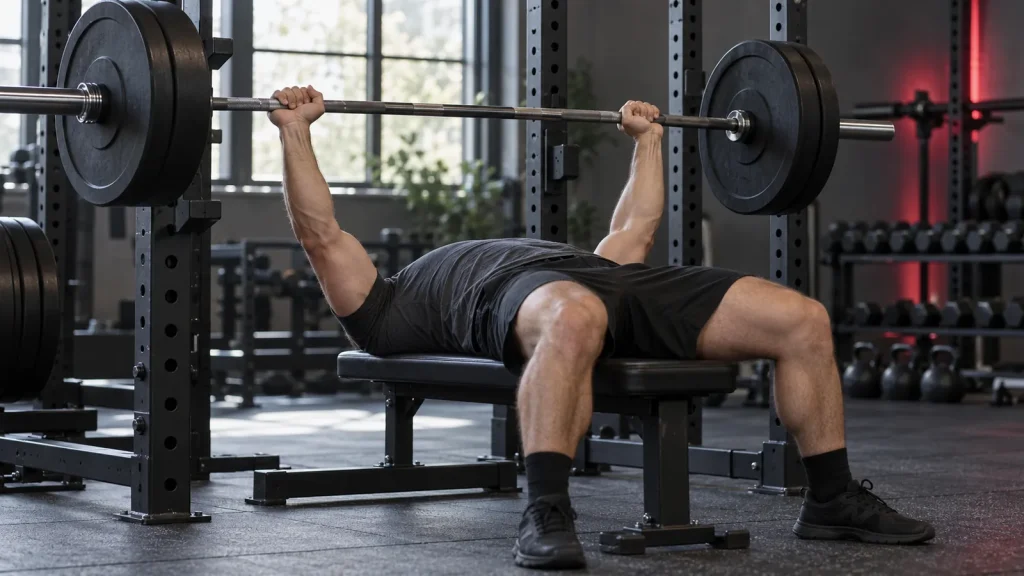
Train on Monday, Wednesday, Friday, or any other days with rest between. Every set uses the same weight, the one you can lift for the written reps.
Workout A
| Lift | Sets and reps |
|---|---|
| Bench press | 2 x 5, 1 x 5+ |
| Squat | 2 x 5, 1 x 5+ |
Workout B
| Lift | Sets and reps |
|---|---|
| Overhead press | 2 x 5, 1 x 5+ |
| Deadlift | 1 x 5+ |
Week pattern: A-B-A / B-A-B, repeating.
Progression and stall rules
Add weight after a clean session
If the last set reaches at least five reps, add weight next session. The common jumps are 2.5 lb (1.25 kg) on bench and press and 5 lb (2.5 kg) on squat and deadlift.
Use the rep-out set as a signal
The last set is written 5+. Stop one or two reps short of failure. Many lifters take a bigger jump after ten or more reps; the book gives the exact rule.
Reset only the lift that stalled
When the 5+ set falls under five reps, cut that lift by about 10%, round down, and climb again. The other lifts keep moving. Sources disagree on whether one miss or two triggers the reset, so check the book.
Move on after repeated stalls
Once a lift has stalled and reset several times, the program has done its job. Move to a program with weekly or monthly structure.
Weekly volume
Work sets per lift, counted from the schedule above (warm-ups not included).
| Lift | Week 1 | Week 2 |
|---|---|---|
| Bench press | 6 | 3 |
| Squat | 6 | 3 |
| Overhead press | 3 | 6 |
| Deadlift | 1 | 2 |
Who it suits
A good fit
- New and returning lifters who want a short, clear plan with room to push on good days.
- People whose sleep and stress swing week to week. A flat day costs reps on the last set instead of failing the workout.
- Anyone with a barbell, rack, bench and plates who can train three days a week, ideally with small plates for the upper-body jumps.
Look elsewhere if
- Lifters who already stall on most lifts every week. You have outgrown a linear plan.
- People who want built-in arm, back and shoulder volume, or a bodybuilding-style split.
- Anyone without small plates. Standard plates are too big for the upper-body jumps.
Common mistakes
Starting too heavy
Start with a weight you can lift for five clean reps with room to spare. Starting near your limit burns through the program in weeks.
Grinding the 5+ set to failure
The extra reps measure progress. They are not a contest. Stop with a rep or two left, or the next session pays for it.
Not writing down the rep count
The 5+ number tells you when to add weight and when to reset. Log it every session.
Resetting every lift at once
Lifts stall at different times. Reset only the one that missed five reps.
Skipping small plates
Without 1.25 lb (0.5 kg) plates you cannot make the smaller upper-body jumps and will stall early.
Your sample week
For each lift, enter: Weight you can lift for 5 reps today. The weights below update as you type. Your numbers stay in your browser and are not saved. The numbers shown are an example lifter.
Workout A
| Set | Reps | Weight (lb) |
|---|---|---|
| 1 | 5 | 95 |
| 2 | 5 | 95 |
| 3 | 5+ | 95 |
| Set | Reps | Weight (lb) |
|---|---|---|
| 1 | 5 | 135 |
| 2 | 5 | 135 |
| 3 | 5+ | 135 |
Workout B
| Set | Reps | Weight (lb) |
|---|---|---|
| 1 | 5 | 65 |
| 2 | 5 | 65 |
| 3 | 5+ | 65 |
| Set | Reps | Weight (lb) |
|---|---|---|
| 1 | 5+ | 135 |
The spreadsheet
The file has three sheets: your numbers, the full week with every weight as a formula, and a progress table that carries the weights forward. It opens in Excel, Numbers and LibreOffice. The weights in the link below use the numbers you typed above.
Open it in Google Sheets
- Download the .xlsx file above.
- Go to Google Drive and choose New, then File upload, and pick the file.
- Double-click the uploaded file and choose Open with Google Sheets.
- Choose File, then Save as Google Sheets so you can edit it.
Want the weights to follow you into the gym? Create a free account and the program loads into Train for you.
How it compares
Greyskull LP vs StrongLifts 5x5
StrongLifts is a fixed five sets of five with a clear pass or fail. Greyskull LP uses fewer sets and ends each lift with a rep-out set, so a bad day costs less and a good day pays more. Read the StrongLifts 5x5 guide.
Greyskull LP vs Phrak's GSLP
Phrak's version keeps the 5+ set and the 10% reset, and adds chin-ups and rows so every session has pulling work. Pick it for a more balanced week. Read the Phrak's GSLP guide.
Greyskull LP vs Starting Strength
Starting Strength is also a novice linear plan, but every set is a fixed five with no rep-out set. Greyskull LP trades some predictability for feedback. Read the Starting Strength guide.
Load Greyskull LP into Train and log each session against the plan.
Start it in Symmetric StrengthThe workouts in Train show each lift as a flat set of five reps. In the program, the last set of each lift is a 5+ set taken for as many clean reps as you can. Use the schedule above for the exact sets.
Common questions
What does the 5+ in Greyskull LP mean?
The final set of each main lift is taken for at least five reps, then as many clean reps as you can. Five is the minimum for adding weight next session.
How much weight do I add each session?
Widely published versions use 2.5 lb (1.25 kg) for bench and overhead press and 5 lb (2.5 kg) for squat and deadlift. A high-rep 5+ set can earn a bigger jump; the book covers that.
What is the reset rule?
If the 5+ set falls below five reps, take roughly 10% off that lift, round down, and work back up. Sources differ on resetting after one miss or after repeating the weight once, so confirm in the book.
Is Greyskull LP free?
The program comes from a paid ebook and paperback by John Sheaffer. This page summarizes it in our own words; the book has the full rules, variations and assistance work.
How long can I run it?
Until you stall repeatedly. For new lifters that is often a few months, and upper-body lifts stall sooner.
Can I add chin-ups or rows?
Many versions do. Phrak's variant builds both into the schedule; see the Phrak's GSLP guide.
Know where you stand
Before you start, check how your lifts compare on the strength standards, estimate a max with the one-rep max calculator, or score your total with the DOTS calculator.
Sources and credit
Greyskull LP was created by John Sheaffer (Johnny Pain) and is described in his book The Greyskull LP. This guide summarizes the core structure in our own words; the book has the full program.
- Greyskull LP: How the Program Works and Who It Suits (gymnoteplus.com)
- GSLP Program Explained (theworkoutmag.com)
- Phrak's Greyskull LP template (liftosaur.com)
- The Greyskull LP by John Sheaffer (Goodreads)
Checked . Symmetric Strength is not affiliated with John Sheaffer or Johnny Pain. Program names are used only to identify the programs.