Powerlifting program for beginners: free 3-day plan and spreadsheet
Beginner · 3 days a week · 12 weeks or until progress slows · Squat, bench press and deadlift
A three-day plan built on the squat, bench press and deadlift, the three lifts a meet judges, for lifters in their first months of training.
Free. The spreadsheet needs no account.
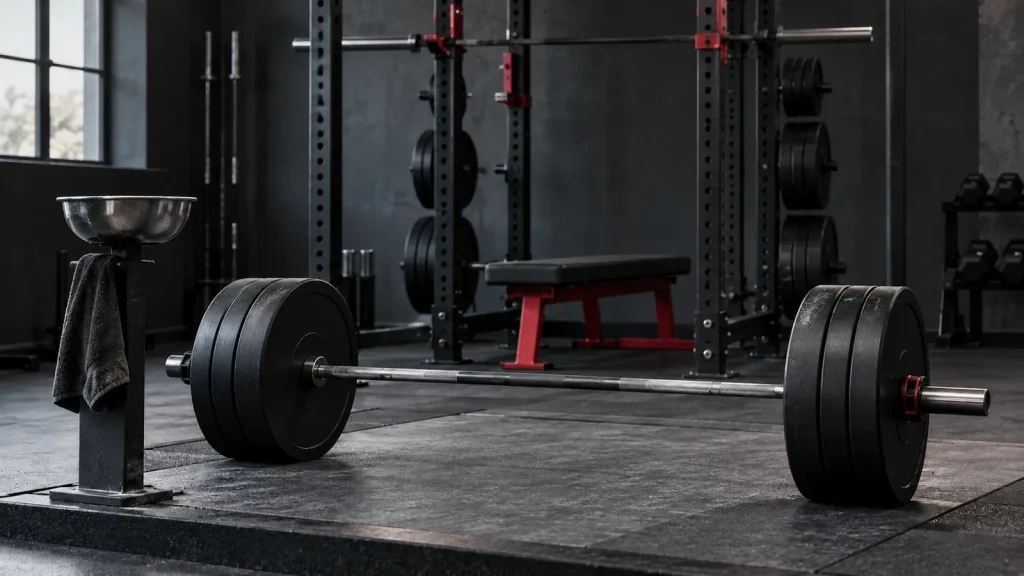
How Powerlifting program for beginners works
Powerlifting is a strength sport built on three barbell lifts: the squat, the bench press and the deadlift. In a meet you get three attempts at each lift, in that order. Your best good attempt on each lift goes into a total, and the total ranks you within your bodyweight class. The IPF Technical Rulebook sets out the rules. Other federations publish their own, so check yours.
Each lift has to meet a standard. In the squat, the top of your legs at the hip must pass below the top of your knees before you stand back up to locked knees. In the bench press, the bar sits motionless on the chest until the signal, then you press to locked elbows. The deadlift ends standing with knees locked and shoulders back. Three referees each control a white light and a red light: white means good lift, red means no lift. Practice full depth and a pause on bench in training so the same reps count on meet day.
The plan is three full sessions a week, such as Monday, Wednesday and Friday. Day 1 is squat and bench for four sets of five, plus rows. Day 2 is deadlift for three sets of five, overhead press and pull-ups. Day 3 repeats squat and bench heavier, with three sets of three on squat and five sets of three on bench, then finishes with Romanian deadlifts for hamstrings and back. We squat and bench twice a week for more practice, and deadlift once because it is the hardest lift to recover from.
Weights come from one number per lift: the load you can move for five clean reps today. Type it into the sheet and it fills in every set for the week. Add weight when the work is done, hold when it is not, and reset when you stall. Those progression rules are our own.
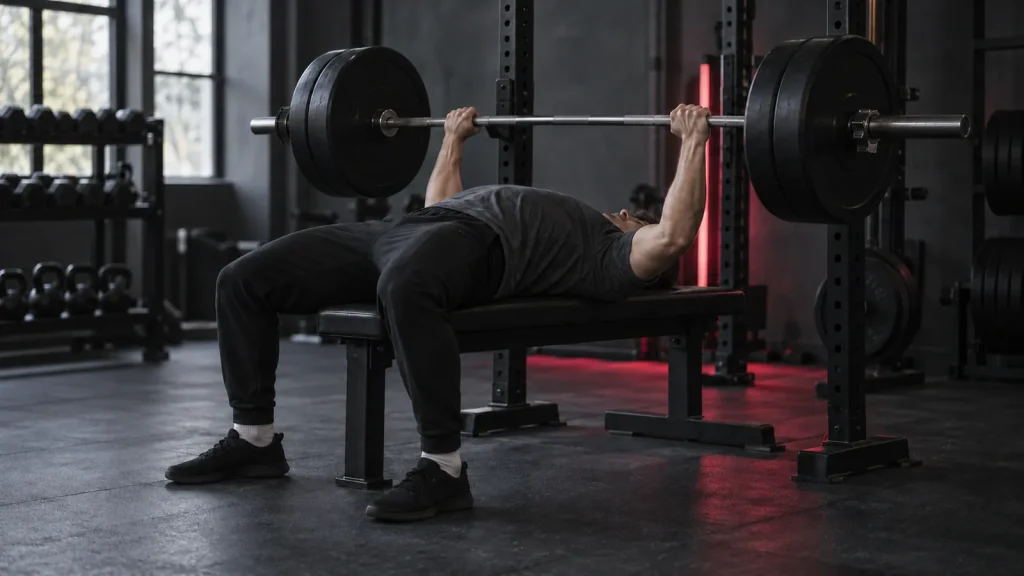
The schedule
Train on Monday, Wednesday, Friday, or any other days with rest between. Every set uses the same weight, the one you can lift for the written reps.
Day 1: squat, bench, row
| Lift | Sets and reps |
|---|---|
| Squat | 4 x 5 |
| Bench press | 4 x 5 |
| Barbell row | 3 x 8 |
Day 2: deadlift, press
| Lift | Sets and reps |
|---|---|
| Deadlift | 3 x 5 |
| Overhead press | 3 x 6 |
Day 3: heavy triples, Romanian deadlift
| Lift | Sets and reps |
|---|---|
| Squat | 3 x 3 |
| Bench press | 5 x 3 |
| Romanian deadlift | 3 x 8 |
Progression and stall rules
Earn the jump with every set
These are our own rules, not a federation standard. When you finish every set and rep on a lift with clean form and a rep or two to spare, add the increment next time you train it. Squat and bench move up on Day 1, deadlift and press on Day 2, and Day 3 weights are rebuilt from the new Day 1 numbers.
Day 3 is heavier, with fewer reps
Triples run about 5% above your five-rep weight. They are your practice at heavy loads, so keep every rep tidy. If Day 3 is grinding, you started too heavy or Day 1 is not recovering.
Miss reps? Repeat the weight
Fail to finish a lift's sets and you repeat that weight next session. Do not add weight to a lift just because the others went well.
Three misses in a row means a reset
If the same lift stalls three sessions running, take 10% off it and build back up. Beginners usually climb back past the old weight in a few weeks.
Take a light week when you drag
After six to eight hard weeks, run one week at about 60% of your usual weights. It costs a week and often buys back several.
Weekly volume
Work sets per lift, counted from the schedule above (warm-ups not included).
| Lift | Sets per week |
|---|---|
| Squat | 7 |
| Bench press | 9 |
| Barbell row | 3 |
| Deadlift | 6 |
| Overhead press | 3 |
Who it suits
A good fit
- Lifters who want to squat, bench and deadlift well, with or without a plan to compete.
- Beginners and early intermediates who can train three days a week and want a clear weekly structure.
- Anyone preparing for a first meet who needs a base before a peaking block.
Look elsewhere if
- Lifters with a meet date inside the next two months. You need a peaking program built around your attempts, such as Candito 6 Week.
- Anyone who is already stalling every week on the main lifts. Texas Method or 5/3/1 suits them better.
- People who want body-part splits or lots of isolation work. This plan keeps accessories to a minimum.
Common mistakes
Training to failure on every set
Stop each working set with a rep or two in reserve. Grinding reps on Day 1 steals from Day 3 and the next week, and it teaches slow, ugly technique.
Skipping the pause on bench
Meets require a still bar on the chest. Practice it from the first session, so a pause is normal when the weight gets heavy.
Squatting high
Depth is pass or fail: the top of your legs at the hip must pass below the top of your knees. Train to that depth or your numbers will not carry over to a meet.
Adding weight too fast
Big jumps use up your easy progress in a month. Small steady additions last longer, and they leave room for a peak.
Ignoring pulling and hamstrings
Rows, pull-ups and Romanian deadlifts protect your back and shoulders and feed your deadlift. Do them, and add weight to them slowly.
Moving to a peaking program too early
Peaking cycles use heavy singles and low volume. If you still add weight most weeks here, you give up progress by switching.
Your sample week
For each lift, enter: Weight you can lift for 5 clean reps today, with one or two reps left. The weights below update as you type. Your numbers stay in your browser and are not saved. The numbers shown are an example lifter.
Day 1: squat, bench, row
| Set | Reps | Weight (lb) |
|---|---|---|
| 1 | 5 | 185 |
| 2 | 5 | 185 |
| 3 | 5 | 185 |
| 4 | 5 | 185 |
| Set | Reps | Weight (lb) |
|---|---|---|
| 1 | 5 | 135 |
| 2 | 5 | 135 |
| 3 | 5 | 135 |
| 4 | 5 | 135 |
| Set | Reps | Weight (lb) |
|---|---|---|
| 1 | 8 | 100 |
| 2 | 8 | 100 |
| 3 | 8 | 100 |
Day 2: deadlift, press
| Set | Reps | Weight (lb) |
|---|---|---|
| 1 | 5 | 225 |
| 2 | 5 | 225 |
| 3 | 5 | 225 |
| Set | Reps | Weight (lb) |
|---|---|---|
| 1 | 6 | 80 |
| 2 | 6 | 80 |
| 3 | 6 | 80 |
Day 3: heavy triples, Romanian deadlift
| Set | Reps | Weight (lb) |
|---|---|---|
| 1 | 3 | 195 |
| 2 | 3 | 195 |
| 3 | 3 | 195 |
| Set | Reps | Weight (lb) |
|---|---|---|
| 1 | 3 | 140 |
| 2 | 3 | 140 |
| 3 | 3 | 140 |
| 4 | 3 | 140 |
| 5 | 3 | 140 |
| Set | Reps | Weight (lb) |
|---|---|---|
| 1 | 8 | 135 |
| 2 | 8 | 135 |
| 3 | 8 | 135 |
The spreadsheet
The file has three sheets: your numbers, the full week with every weight as a formula, and a progress table that carries the weights forward. It opens in Excel, Numbers and LibreOffice. The weights in the link below use the numbers you typed above.
Open it in Google Sheets
- Download the .xlsx file above.
- Go to Google Drive and choose New, then File upload, and pick the file.
- Double-click the uploaded file and choose Open with Google Sheets.
- Choose File, then Save as Google Sheets so you can edit it.
Want the weights to follow you into the gym? Create a free account and the program loads into Train for you.
How it compares
Powerlifting program for beginners vs Candito 6 Week
A six-week block for intermediate lifters, five sessions a week. Volume comes first, heavier work follows, and the block ends in a max test. Choose it when you want a defined push to new maxes. Read the Candito 6 Week guide.
Powerlifting program for beginners vs Sheiko
A high-frequency method from coach Boris Sheiko: the three lifts several times a week, mostly at moderate percentages, in four-week blocks. Our Sheiko guide rates it intermediate, so treat it as a second stage. Read the Sheiko guide.
Powerlifting program for beginners vs 5/3/1
A four-day plan on a four-week wave, with the training max rising once per cycle. A good move once session-to-session progress here has ended and you want slow, steady gains. Read the 5/3/1 guide.
Powerlifting program for beginners vs Texas Method
Volume, light and intensity days, with a Friday attempt at a record set of five. It suits lifters who stall on this plan but still recover well from a hard week. Read the Texas Method guide.
Powerlifting program for beginners vs Conjugate method
A four-day system for experienced lifters that rotates max-effort, dynamic-effort and repeated-effort work. It asks for more judgement than this plan, so it comes later. Read the Conjugate method guide.
Load Powerlifting program for beginners into Train and log each session against the plan.
Start it in Symmetric StrengthThe workouts in Train carry the three lift days. Pull-ups on Day 2 are bodyweight, so the sheet leaves them out and the app lists them as three sets of six.
Common questions
What is a good powerlifting program for a beginner?
One that trains the squat, bench press and deadlift at least once a week each, builds weight gradually, and does not need much equipment. This three-day plan does that in three sessions a week, and the sheet fills in every weight from five-rep numbers you enter.
How is a powerlifting routine different from a bodybuilding routine?
Powerlifting is judged by how much you lift on three specific lifts, so training centres on getting stronger at them. Sets are heavier and lower in reps, and accessory work supports the big three. Bodybuilding targets muscle size and shape, with more exercises and more volume per muscle.
How long should I run this before a peaking program?
Run it while you can add weight most weeks. For many beginners that is three to six months. When two or three lifts stall after resets, you are ready for a structured peaking block.
When should I move to a peaking program?
Move when you have a meet date or a test date six to twelve weeks out and your strength base is steady. Candito 6 Week is a six-week block that builds from high volume to heavier work and ends in a max test. Sheiko is a high-frequency method at moderate loads, with a separate competition-prep program that tapers into a meet. Both assume you already squat, bench and deadlift with good technique.
What if I want something between this and a peaking plan?
Texas Method gives you a volume day, a light day and a Friday record set of five. 5/3/1 runs a four-week wave from a training max, one main lift per day over four days. Both suit lifters who no longer progress session to session.
Do I need a belt, knee sleeves or special shoes?
No. Start with what you have. A belt and flat shoes help once the weights get heavy, but you can learn all three lifts without gear. The IPF rulebook lists what is allowed in competition and separates classic lifting from equipped lifting.
Do pull-ups go in the spreadsheet?
No, they are bodyweight. The workout in Train lists three sets of six. Add reps before you add weight.
Know where you stand
Before you start, check how your lifts compare on the strength standards, estimate a max with the one-rep max calculator, or score your total with the DOTS calculator.
Sources and credit
Powerlifting Foundations is our own program from Symmetric Strength. Meet rules described here come from the IPF Technical Rulebook; check your federation's current rulebook before you enter a meet.
- IPF Technical Rulebook, effective 1 March 2026 (International Powerlifting Federation)
- IPF technical rules page (International Powerlifting Federation)
- Powerlifting overview (Wikipedia)
Checked . Symmetric Strength is not affiliated with Symmetric Strength. Program names are used only to identify the programs.