Conjugate method (Westside) guide and free spreadsheet
Advanced · 4 days a week · 3 weeks · Max effort, dynamic effort and repeated effort for powerlifters
A four-day powerlifting system built around heavy, fast and high-rep work. It suits experienced lifters and takes real judgement to run well.
Free. The spreadsheet needs no account.
How Conjugate method (Westside Barbell) works
The conjugate method trains three qualities in the same week. Max effort works up to the heaviest load you can lift that day. Dynamic effort moves a lighter load as fast as you can. Repeated effort is higher-volume accessory work for muscle and weak points.
Westside generally runs four days: max effort lower, max effort upper, dynamic effort lower and dynamic effort upper, with repeated effort accessories finishing each session. It puts about 20% of the work on the main lifts and 80% on special exercises.
The max effort exercise changes every week, so you rarely repeat a lift. Dynamic effort runs in a three-week wave, then the movement changes.
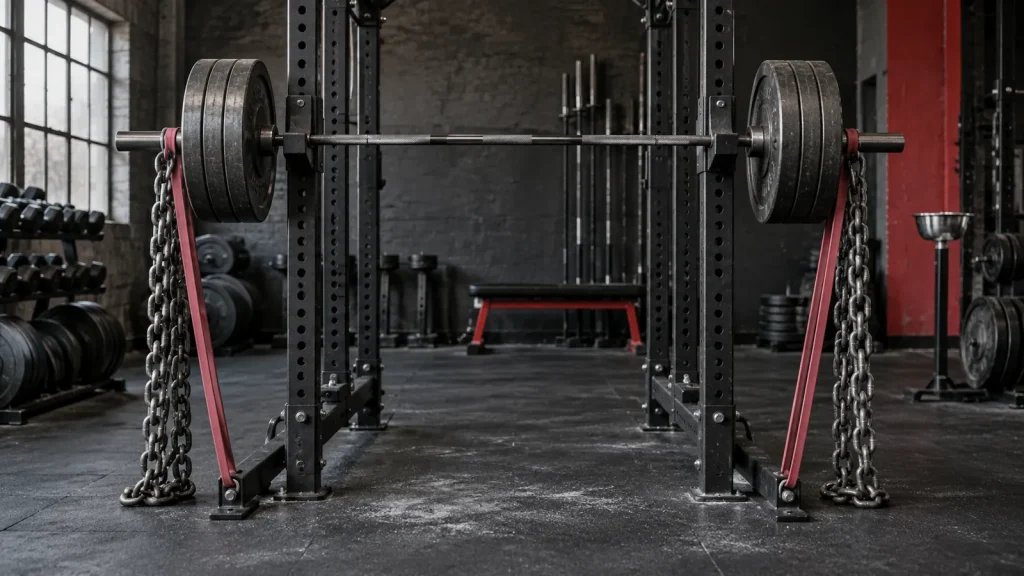
Speed days often add bands or chains, which make the bar harder near lockout. Westside programs the box squat and deadlift on dynamic effort lower days.
The method has many versions. The sheet shows one readable sample week with our own percentages and the in-app templates. It is a pattern, not a finished plan for you. A coach who knows your weak points will pick different exercises.

The schedule
Train on Monday, Tuesday, Thursday, Friday, or any other days with rest between. Percentages are of your training max, which is 100% of your one-rep max.
Max effort lower
| Lift | Sets and reps |
|---|---|
| Deadlift work-up to a heavy triple | 1 x 5 @ 50%, 1 x 3 @ 70%, 1 x 2 @ 80%, 1 x 3 @ 90% |
| Romanian deadlift | 4 x 8 @ 100% |
Max effort upper
| Lift | Sets and reps |
|---|---|
| Bench press work-up to a heavy triple | 1 x 5 @ 50%, 1 x 3 @ 70%, 1 x 2 @ 80%, 1 x 3 @ 90% |
| Barbell row | 4 x 8 @ 100% |
| Overhead press | 3 x 8 @ 100% |
Dynamic effort lower, wave week 1
| Lift | Sets and reps |
|---|---|
| Speed squat | 10 x 2 @ 50% |
| Speed deadlift | 6 x 1 @ 50% |
Dynamic effort upper, wave week 1
| Lift | Sets and reps |
|---|---|
| Speed bench press | 9 x 3 @ 50% |
| Barbell row | 4 x 10 @ 100% |
Dynamic effort lower, wave week 2
| Lift | Sets and reps |
|---|---|
| Speed squat | 10 x 2 @ 55% |
| Speed deadlift | 6 x 1 @ 55% |
Dynamic effort upper, wave week 2
| Lift | Sets and reps |
|---|---|
| Speed bench press | 9 x 3 @ 55% |
| Barbell row | 4 x 10 @ 100% |
Dynamic effort lower, wave week 3
| Lift | Sets and reps |
|---|---|
| Speed squat | 10 x 2 @ 60% |
| Speed deadlift | 6 x 1 @ 60% |
Dynamic effort upper, wave week 3
| Lift | Sets and reps |
|---|---|
| Speed bench press | 9 x 3 @ 60% |
| Barbell row | 4 x 10 @ 100% |
Week pattern: MEL-MEU-DL1-DU1 / MEL-MEU-DL2-DU2 / MEL-MEU-DL3-DU3, repeating.
A plus sign means AMRAP: do as many good reps as you can on that set.
Progression and stall rules
Max effort: change the exercise every week
Westside works up to the heaviest set possible that day on one variation, then moves to a different variation the next week, and it says to rotate the max effort lift weekly. The work-up steps and the triple at 90% in the sheet are our suggestion, not Westside's. Treat that load as a ceiling for a new exercise, not a target.
Dynamic effort: a three-week wave
Speed days use a light bar moved fast, in a three-week wave, then the movement changes and the wave restarts. Westside's own lower-body waves are heavier than ours: 12x2 at 75%, 10x2 at 80%, 8x2 at 85%, or 5x5 at 70, 75 and 80%. The 50, 55 and 60% in the sheet are our lighter suggestion for bar weight. Add band or chain tension on top if you use it.
Retest and reset after the wave
Westside retests about every nine weeks. The 5 lb (2.5 kg) added to every starting weight after each three-week wave is our suggestion. Raise it only if the speed days stayed fast. If the bar slowed, repeat the wave at the same weight.
Repeated effort picks up the slack
Accessory work finishes each day. Westside picks it to build muscle and fix weak points, such as split squats for weak quads or JM presses for weak triceps. The 8 to 10 rep sets in the sheet are our placeholders. Swap in your own picks.
If a lift stalls, change the variation first
Do not grind the same lift. This is our advice, not a Westside rule: change the bar, stance, box height or resistance, then work back up.
Weekly volume
Work sets per lift, counted from the schedule above (warm-ups not included).
| Lift | Week 1 | Week 2 | Week 3 |
|---|---|---|---|
| Deadlift work-up to a heavy triple | 10 | 10 | 10 |
| Romanian deadlift | 4 | 4 | 4 |
| Bench press work-up to a heavy triple | 13 | 13 | 13 |
| Barbell row | 8 | 8 | 8 |
| Overhead press | 3 | 3 | 3 |
| Speed squat | 10 | 10 | 10 |
Who it suits
A good fit
- Experienced lifters with a solid base in the squat, bench press and deadlift who want a break from percentage-based cycles.
- Powerlifters who can name their weak point and want a plan that attacks it with chosen exercises.
- People who enjoy variety and can judge fatigue and bar speed by feel.
Look elsewhere if
- Beginners who can still add weight every session. A simpler program builds more strength with less guesswork.
- Lifters who want the plan written for them week by week. The method asks you to choose exercises.
- Anyone without a rack, safety bars or a spotter for heavy singles and triples, or who trains with limited equipment and no bands or boxes.
Common mistakes
Using speed days as extra max days
Dynamic effort is light and quick. If the bar slows, the weight is too high, and grinding tires you for the next heavy day.
Maxing out too often on the same lift
Max effort rotates the exercise to avoid burnout (Westside). Repeating one variation week after week undoes that.
Chasing a max on every variation
A good set on a new exercise is worth a note, not a record at all cost. Leave a rep or two in the tank unless you are testing a meet lift.
Skipping accessories
Westside puts about 80% of the work in special exercises. Skip them and you have thrown away most of the method.
Copying a champion's plan
Elite lifters built up to their volume over years. Copying it without their base and recovery invites injury and stalls.
Your sample week
For each lift, enter: Your current one-rep max on the three competition lifts, and your working weight for the three accessory lifts. The weights below update as you type. Your numbers stay in your browser and are not saved. The numbers shown are an example lifter.
Max effort lower
| Set | Reps | Weight (lb) |
|---|---|---|
| 1 | 5 | 205 |
| 2 | 3 | 285 |
| 3 | 2 | 325 |
| 4 | 3 | 365 |
| Set | Reps | Weight (lb) |
|---|---|---|
| 1 | 8 | 225 |
| 2 | 8 | 225 |
| 3 | 8 | 225 |
| 4 | 8 | 225 |
Max effort upper
| Set | Reps | Weight (lb) |
|---|---|---|
| 1 | 5 | 115 |
| 2 | 3 | 160 |
| 3 | 2 | 180 |
| 4 | 3 | 205 |
| Set | Reps | Weight (lb) |
|---|---|---|
| 1 | 8 | 155 |
| 2 | 8 | 155 |
| 3 | 8 | 155 |
| 4 | 8 | 155 |
| Set | Reps | Weight (lb) |
|---|---|---|
| 1 | 8 | 95 |
| 2 | 8 | 95 |
| 3 | 8 | 95 |
Dynamic effort lower, wave week 1
| Set | Reps | Weight (lb) |
|---|---|---|
| 1 | 2 | 160 |
| 2 | 2 | 160 |
| 3 | 2 | 160 |
| 4 | 2 | 160 |
| 5 | 2 | 160 |
| 6 | 2 | 160 |
| 7 | 2 | 160 |
| 8 | 2 | 160 |
| 9 | 2 | 160 |
| 10 | 2 | 160 |
| Set | Reps | Weight (lb) |
|---|---|---|
| 1 | 1 | 205 |
| 2 | 1 | 205 |
| 3 | 1 | 205 |
| 4 | 1 | 205 |
| 5 | 1 | 205 |
| 6 | 1 | 205 |
Dynamic effort upper, wave week 1
| Set | Reps | Weight (lb) |
|---|---|---|
| 1 | 3 | 115 |
| 2 | 3 | 115 |
| 3 | 3 | 115 |
| 4 | 3 | 115 |
| 5 | 3 | 115 |
| 6 | 3 | 115 |
| 7 | 3 | 115 |
| 8 | 3 | 115 |
| 9 | 3 | 115 |
| Set | Reps | Weight (lb) |
|---|---|---|
| 1 | 10 | 155 |
| 2 | 10 | 155 |
| 3 | 10 | 155 |
| 4 | 10 | 155 |
Dynamic effort lower, wave week 2
| Set | Reps | Weight (lb) |
|---|---|---|
| 1 | 2 | 175 |
| 2 | 2 | 175 |
| 3 | 2 | 175 |
| 4 | 2 | 175 |
| 5 | 2 | 175 |
| 6 | 2 | 175 |
| 7 | 2 | 175 |
| 8 | 2 | 175 |
| 9 | 2 | 175 |
| 10 | 2 | 175 |
| Set | Reps | Weight (lb) |
|---|---|---|
| 1 | 1 | 225 |
| 2 | 1 | 225 |
| 3 | 1 | 225 |
| 4 | 1 | 225 |
| 5 | 1 | 225 |
| 6 | 1 | 225 |
Dynamic effort upper, wave week 2
| Set | Reps | Weight (lb) |
|---|---|---|
| 1 | 3 | 125 |
| 2 | 3 | 125 |
| 3 | 3 | 125 |
| 4 | 3 | 125 |
| 5 | 3 | 125 |
| 6 | 3 | 125 |
| 7 | 3 | 125 |
| 8 | 3 | 125 |
| 9 | 3 | 125 |
| Set | Reps | Weight (lb) |
|---|---|---|
| 1 | 10 | 155 |
| 2 | 10 | 155 |
| 3 | 10 | 155 |
| 4 | 10 | 155 |
Dynamic effort lower, wave week 3
| Set | Reps | Weight (lb) |
|---|---|---|
| 1 | 2 | 190 |
| 2 | 2 | 190 |
| 3 | 2 | 190 |
| 4 | 2 | 190 |
| 5 | 2 | 190 |
| 6 | 2 | 190 |
| 7 | 2 | 190 |
| 8 | 2 | 190 |
| 9 | 2 | 190 |
| 10 | 2 | 190 |
| Set | Reps | Weight (lb) |
|---|---|---|
| 1 | 1 | 245 |
| 2 | 1 | 245 |
| 3 | 1 | 245 |
| 4 | 1 | 245 |
| 5 | 1 | 245 |
| 6 | 1 | 245 |
Dynamic effort upper, wave week 3
| Set | Reps | Weight (lb) |
|---|---|---|
| 1 | 3 | 135 |
| 2 | 3 | 135 |
| 3 | 3 | 135 |
| 4 | 3 | 135 |
| 5 | 3 | 135 |
| 6 | 3 | 135 |
| 7 | 3 | 135 |
| 8 | 3 | 135 |
| 9 | 3 | 135 |
| Set | Reps | Weight (lb) |
|---|---|---|
| 1 | 10 | 155 |
| 2 | 10 | 155 |
| 3 | 10 | 155 |
| 4 | 10 | 155 |
The spreadsheet
The file has three sheets: your numbers, the full week with every weight as a formula, and a progress table that carries the weights forward. It opens in Excel, Numbers and LibreOffice. The weights in the link below use the numbers you typed above.
Open it in Google Sheets
- Download the .xlsx file above.
- Go to Google Drive and choose New, then File upload, and pick the file.
- Double-click the uploaded file and choose Open with Google Sheets.
- Choose File, then Save as Google Sheets so you can edit it.
Want the weights to follow you into the gym? Create a free account and the program loads into Train for you.
How it compares
Conjugate method (Westside Barbell) vs Powerlifting program
A standard powerlifting program repeats the competition lifts and raises percentages over weeks. The conjugate method rotates variations and trains speed and heavy work together, so it needs more judgement. Read the Powerlifting program guide.
Conjugate method (Westside Barbell) vs Sheiko
Sheiko plans every set and percentage in advance and keeps the competition lifts at the centre. Conjugate leaves exercise choice to you and swaps the heavy lift weekly. Read the Sheiko guide.
Conjugate method (Westside Barbell) vs 5/3/1
5/3/1 is a simple, fixed monthly plan built on a few lifts. Conjugate is less predictable and asks for more skill, but gives more variety. Read the 5/3/1 guide.
Load Conjugate method (Westside Barbell) into Train and log each session against the plan.
Start it in Symmetric StrengthThe workouts in Train carry one fixed exercise per day. The real method rotates the max effort lift every week, adds bands or chains on speed days and picks accessories for your own weak points. The percentages and work-up on this page are our suggestion, not Westside's. Choose the variations yourself.
Common questions
Who created the conjugate method?
Louie Simmons developed it through his Westside Barbell gym, and Westside Barbell publishes its own description of the method on its official site. This guide is an independent summary.
What is the difference between max effort and dynamic effort?
Max effort means working up to the heaviest set you can do that day on a main exercise or a variation such as the floor press or good morning. Dynamic effort means moving a lighter load as fast as possible, often against bands or chains.
Do I have to use bands and chains?
No. They are common on speed days, but the method does not need them. Without them, keep the bar light and fast and add weight across the wave. The sheet lists bar percentages only.
How often should I change the max effort exercise?
Westside rotates it weekly, and the dynamic effort movement changes after each three-week wave. Pick variations that fit your weak points and skip ones that hurt.
Can I run it on fewer than four days?
Yes. Westside says to modify the four-day layout for athletes with only two or three days. How to cut it is our suggestion: keep the heavy and fast work and trim accessory volume first.
What does the spreadsheet cover?
It sets a heavy top triple, three speed waves and the accessory sets from your numbers. All percentages are our suggestion, not Westside's. Exercise choices, bands, chains and box heights are yours.
Know where you stand
Before you start, check how your lifts compare on the strength standards, estimate a max with the one-rep max calculator, or score your total with the DOTS calculator.
Sources and credit
The conjugate method is the work of Louie Simmons and Westside Barbell. This guide describes it in our own words and links their official site, which has the full method. The sample percentages, work-up steps and 5 lb jump are our own suggestion, not Westside's.
- Official Conjugate method (Westside Barbell) source
- A Walkthrough of a Conjugate Method Training Week (Westside Barbell)
Checked . Symmetric Strength is not affiliated with Louie Simmons or Westside Barbell. Program names are used only to identify the programs.