5 day workout split guide and free spreadsheet
Intermediate · 5 days a week · Ongoing, in blocks of 8 to 12 weeks · Upper, lower, push, pull and legs, so every muscle gets two sessions a week
A five-day week that trains every muscle twice: an upper day and a lower day first, then push, pull and legs. It suits lifters who can train five days and want the twice-a-week frequency that research tends to favor, with some of the focus of a classic body-part split.
Free. The spreadsheet needs no account.
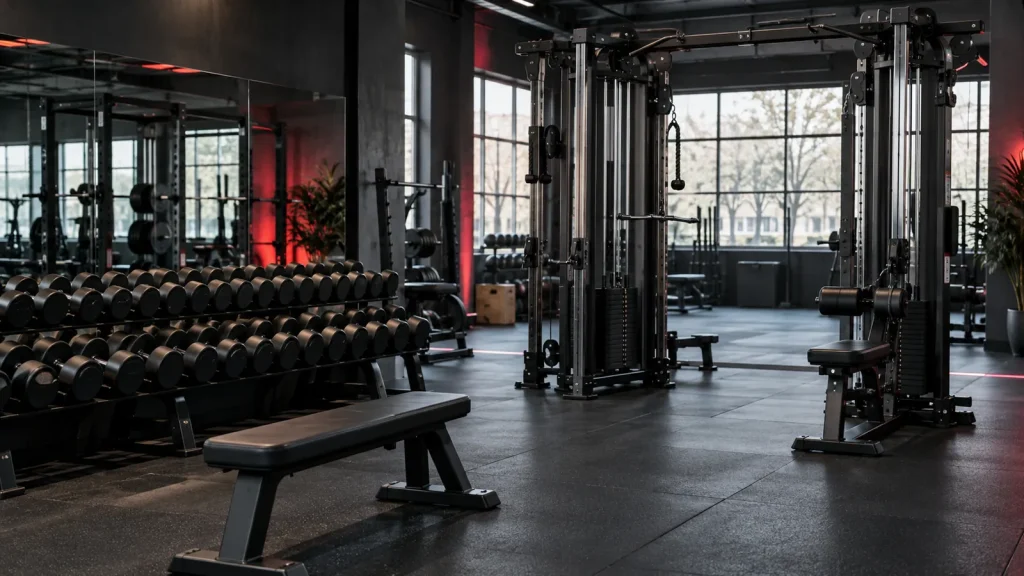
How 5 day workout split works
There are two common ways to run a 5 day workout split. The classic version gives each day to one body part, usually chest, back, shoulders, legs and arms. We cover it in the bro split guide. Each muscle is trained once a week, with all its sets in one session.
This guide uses the second way, a hybrid of upper/lower and push/pull/legs. Monday is Upper, Tuesday is Lower, Wednesday is Push, Thursday is Pull and Friday is Legs. Chest, back and shoulders are each trained twice, once on Upper and once on Push or Pull. The legs are trained twice, once on Lower and once on Legs. This layout is our own design, not a published template.
The first two days are the heavy ones. Upper opens with bench press and barbell rows for 4 sets of 5 and 6. Lower opens with squats for 4 sets of 5. The last three days use higher reps (8 to 15), more machines and cables, and isolation work for the shoulders and arms. Putting the heavy days first in the week means you lift them fresh.
Counting the in-app templates, a muscle sees these weekly sets. Chest gets 10 (bench 4, incline 3, dips 3). Back gets 13 (barbell row 4, pull-ups 3, pulldown 3, cable row 3). Shoulders get 12, from overhead press, dumbbell press, lateral raises and face pulls. Quadriceps get 16 across squat, leg press, front squat, split squat and leg extensions. Hamstrings get 6 direct sets, from Romanian deadlifts and leg curls, plus the squat work. Calves get 6. Biceps get 5 and triceps 3 direct sets, plus pressing. These counts are what the templates carry, and they are a base to add to, not a target from a source.
Our templates are a simplified version. They carry the lifts and set counts above and nothing else. Add sets slowly where you lag, and drop the isolation work first if the week runs long.
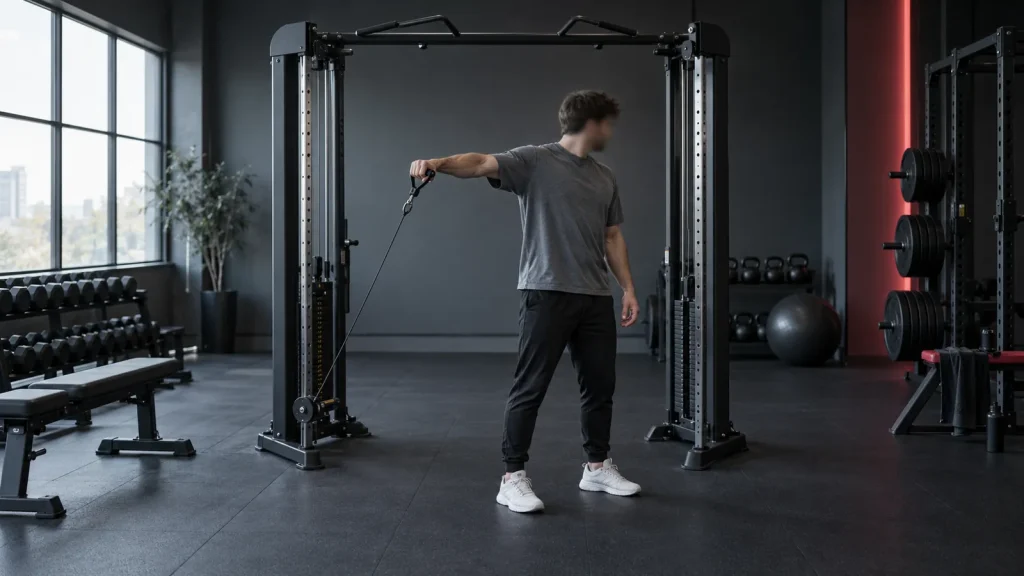
The schedule
Train on Monday, Tuesday, Wednesday, Thursday, Friday, or any other days with rest between. Every set uses the same weight, the one you can lift for the written reps.
Upper
| Lift | Sets and reps |
|---|---|
| Bench press | 4 x 5 |
| Barbell row | 4 x 6 |
| Overhead press | 3 x 8 |
| Pull-up | 3 x 8 |
Lower
| Lift | Sets and reps |
|---|---|
| Squat | 4 x 5 |
| Romanian deadlift | 3 x 8 |
| Leg press | 3 x 10 |
| Calf raise | 3 x 12 |
Push
| Lift | Sets and reps |
|---|---|
| Incline bench press | 3 x 8 |
| Dumbbell shoulder press | 3 x 10 |
| Dip | 3 x 10 |
| Lateral raise | 3 x 15 |
| Triceps pushdown | 3 x 12 |
Pull
| Lift | Sets and reps |
|---|---|
| Lat pulldown | 3 x 10 |
| Seated cable row | 3 x 10 |
| Face pull | 3 x 15 |
| Barbell curl | 3 x 10 |
| Hammer curl | 2 x 12 |
Legs
| Lift | Sets and reps |
|---|---|
| Front squat | 3 x 8 |
| Split squat | 3 x 10 |
| Leg extension | 3 x 12 |
| Leg curl | 3 x 12 |
| Calf raise | 3 x 15 |
Progression and stall rules
All of these rules are ours
This 5 day split is our own program, so no outside source sets its loads or progression. The spreadsheet adds a small jump each session only so you can see the weights move. In real training, use the rep rule below.
Double progression
Each lift has a rep target, such as 5 on bench press or 12 on leg curls. Treat it as the bottom of a range about 2 to 4 reps wide. When every set reaches the top of the range with a rep or two in reserve, add the smallest jump you have and start again at the bottom.
Heavy first, lighter later in the week
The first lift of Upper and Lower is the heavy one, at 4 sets of 5 or 6. Push, Pull and Legs days use higher reps and smaller jumps. Keep one or two reps in reserve on the big lifts and take the last set of each isolation lift close to failure.
Stall rule
If a lift fails to add a rep or a jump for three sessions in a row, drop its weight by about 10% and build back up. If most lifts stall at once, you are short on sleep, food or recovery, so deload before changing exercises.
Deload every 6 to 8 weeks
Five training days is a lot of work. Every 6 to 8 weeks, or sooner if your lifts feel flat, run a week at about 60% of normal weights and cut one set from each exercise. Both the schedule and the numbers are our defaults.
Pull-ups and dips
Start them at bodyweight and leave the added weight at 0. Add load only once every set reaches the top of the rep range.
Weekly volume
Work sets per lift, counted from the schedule above (warm-ups not included).
| Lift | Sets per week |
|---|---|
| Bench press | 4 |
| Barbell row | 4 |
| Overhead press | 3 |
| Pull-up | 3 |
| Squat | 4 |
| Romanian deadlift | 3 |
| Leg press | 3 |
| Calf raise | 3 |
| Incline bench press | 3 |
| Dumbbell shoulder press | 3 |
| Dip | 3 |
| Lateral raise | 3 |
| Triceps pushdown | 3 |
| Lat pulldown | 3 |
| Seated cable row | 3 |
| Face pull | 3 |
| Barbell curl | 3 |
| Hammer curl | 2 |
| Front squat | 3 |
| Split squat | 3 |
| Leg extension | 3 |
| Leg curl | 3 |
| Calf raise | 3 |
Who it suits
A good fit
- Lifters with a year or more of consistent training who can reach the gym five days a week.
- Anyone leaving a once-a-week body-part split who wants every muscle trained twice without going to a six-day push/pull/legs week.
- People who like heavy compound lifts early in the week and pump work to finish it.
Look elsewhere if
- Beginners. A full-body or upper/lower plan teaches the lifts faster and needs less gym time.
- Anyone who can train only three or four days. Our upper/lower guide trains every muscle twice in four days.
- Lifters short on recovery. Five days with two leg sessions and two heavy squat-pattern days will catch up with you if sleep and food are poor.
- People who want to chase a one-rep max. A strength program with a percentage plan is a better tool.
Common mistakes
Treating every day as a max day
Only the first lift on Upper and Lower is heavy. On Push, Pull and Legs, work in the 8 to 15 rep range, stop a rep or two short on compound lifts and save failure for the final set of isolation exercises.
Stacking leg fatigue
Lower comes on Tuesday and Legs on Friday, with a push day and a pull day between them. If Friday legs feel wrecked, cut a set from the leg extension or split squat before you cut the squat.
Adding arm and shoulder sets on top of all the pressing
Bench, incline, overhead press, dips and dumbbell press all load the front delts and triceps. Keep lateral raises and pushdowns where they are before you add more.
Skipping the small lifts when the week gets busy
Face pulls, curls and calf work are where Push, Pull and Legs earn their keep. Do them with fewer sets rather than dropping them.
Never taking a lighter week
Five days builds fatigue. Take a planned lighter week every 6 to 8 weeks instead of waiting for a lift to fail.
Changing the lifts every week
You cannot see progress if the exercises keep moving. Keep the same list for a full 8 to 12 week block and beat your last logged session.
Your sample week
For each lift, enter: Weight you use for your working sets. The weights below update as you type. Your numbers stay in your browser and are not saved. The numbers shown are an example lifter.
Upper
| Set | Reps | Weight (lb) |
|---|---|---|
| 1 | 5 | 135 |
| 2 | 5 | 135 |
| 3 | 5 | 135 |
| 4 | 5 | 135 |
| Set | Reps | Weight (lb) |
|---|---|---|
| 1 | 6 | 115 |
| 2 | 6 | 115 |
| 3 | 6 | 115 |
| 4 | 6 | 115 |
| Set | Reps | Weight (lb) |
|---|---|---|
| 1 | 8 | 85 |
| 2 | 8 | 85 |
| 3 | 8 | 85 |
| Set | Reps | Weight (lb) |
|---|---|---|
| 1 | 8 | 0 |
| 2 | 8 | 0 |
| 3 | 8 | 0 |
Lower
| Set | Reps | Weight (lb) |
|---|---|---|
| 1 | 5 | 185 |
| 2 | 5 | 185 |
| 3 | 5 | 185 |
| 4 | 5 | 185 |
| Set | Reps | Weight (lb) |
|---|---|---|
| 1 | 8 | 135 |
| 2 | 8 | 135 |
| 3 | 8 | 135 |
| Set | Reps | Weight (lb) |
|---|---|---|
| 1 | 10 | 270 |
| 2 | 10 | 270 |
| 3 | 10 | 270 |
| Set | Reps | Weight (lb) |
|---|---|---|
| 1 | 12 | 135 |
| 2 | 12 | 135 |
| 3 | 12 | 135 |
Push
| Set | Reps | Weight (lb) |
|---|---|---|
| 1 | 8 | 95 |
| 2 | 8 | 95 |
| 3 | 8 | 95 |
| Set | Reps | Weight (lb) |
|---|---|---|
| 1 | 10 | 30 |
| 2 | 10 | 30 |
| 3 | 10 | 30 |
| Set | Reps | Weight (lb) |
|---|---|---|
| 1 | 10 | 0 |
| 2 | 10 | 0 |
| 3 | 10 | 0 |
| Set | Reps | Weight (lb) |
|---|---|---|
| 1 | 15 | 15 |
| 2 | 15 | 15 |
| 3 | 15 | 15 |
| Set | Reps | Weight (lb) |
|---|---|---|
| 1 | 12 | 50 |
| 2 | 12 | 50 |
| 3 | 12 | 50 |
Pull
| Set | Reps | Weight (lb) |
|---|---|---|
| 1 | 10 | 100 |
| 2 | 10 | 100 |
| 3 | 10 | 100 |
| Set | Reps | Weight (lb) |
|---|---|---|
| 1 | 10 | 100 |
| 2 | 10 | 100 |
| 3 | 10 | 100 |
| Set | Reps | Weight (lb) |
|---|---|---|
| 1 | 15 | 40 |
| 2 | 15 | 40 |
| 3 | 15 | 40 |
| Set | Reps | Weight (lb) |
|---|---|---|
| 1 | 10 | 65 |
| 2 | 10 | 65 |
| 3 | 10 | 65 |
| Set | Reps | Weight (lb) |
|---|---|---|
| 1 | 12 | 25 |
| 2 | 12 | 25 |
Legs
| Set | Reps | Weight (lb) |
|---|---|---|
| 1 | 8 | 95 |
| 2 | 8 | 95 |
| 3 | 8 | 95 |
| Set | Reps | Weight (lb) |
|---|---|---|
| 1 | 10 | 65 |
| 2 | 10 | 65 |
| 3 | 10 | 65 |
| Set | Reps | Weight (lb) |
|---|---|---|
| 1 | 12 | 90 |
| 2 | 12 | 90 |
| 3 | 12 | 90 |
| Set | Reps | Weight (lb) |
|---|---|---|
| 1 | 12 | 70 |
| 2 | 12 | 70 |
| 3 | 12 | 70 |
| Set | Reps | Weight (lb) |
|---|---|---|
| 1 | 15 | 135 |
| 2 | 15 | 135 |
| 3 | 15 | 135 |
The spreadsheet
The file has three sheets: your numbers, the full week with every weight as a formula, and a progress table that carries the weights forward. It opens in Excel, Numbers and LibreOffice. The weights in the link below use the numbers you typed above.
Open it in Google Sheets
- Download the .xlsx file above.
- Go to Google Drive and choose New, then File upload, and pick the file.
- Double-click the uploaded file and choose Open with Google Sheets.
- Choose File, then Save as Google Sheets so you can edit it.
Want the weights to follow you into the gym? Create a free account and the program loads into Train for you.
How it compares
5 day workout split vs Bro split
The bro split is the classic version of a 5 day split, with one muscle per day. Each muscle trains once a week, and research leans toward twice. Pick the bro split if you want one muscle per day and long, focused sessions. Pick this guide if you want five days with chest, back, shoulders and legs getting a second session. Read the Bro split guide.
5 day workout split vs PHUL
PHUL gets two sessions per muscle in four days, with two heavy days and two size days. This split uses a fifth day for push, pull and legs work, and has more room for sets on the shoulders, arms and calves. PHUL asks for one fewer day. Read the PHUL guide.
5 day workout split vs Upper lower split
Upper/lower trains every muscle twice in four days. Pick it if four days is what your week allows. Pick this guide if you can train five days and want separate push, pull and leg sessions in the second half of the week. Read the Upper lower split guide.
5 day workout split vs Push/Pull/Legs
Push/pull/legs needs six days to train each muscle twice. Pick it if you can train six days. This guide fits the same muscles into five by opening the week with one upper and one lower day. Read the Push/Pull/Legs guide.
Load 5 day workout split into Train and log each session against the plan.
Start it in Symmetric StrengthThe workouts in Train are a simplified version of this program, with one rep count per lift. Use the schedule above for the exact sets.
Common questions
What is a 5 day workout split?
It is a weekly plan with five training days and two days off. The classic form gives each day to one body part, such as chest, back, shoulders, legs and arms. The version in this guide runs upper, lower, push, pull and legs so every muscle is trained twice.
Is a 5 day split better than a 3 or 4 day split?
Not automatically. Schoenfeld and colleagues' 2016 meta-analysis compared training a muscle once a week with more often and favored the higher frequencies. Stronger by Science, reviewing 13 studies, found a small edge for higher frequency that was not significant for direct measures such as muscle thickness, and it calls the data noisy. A 4 day upper/lower week already trains every muscle twice. A fifth day gives you more room for weekly sets and variety, not a different rule of growth.
What is the difference between the classic 5 day split and this one?
The classic split trains each muscle once a week in a single long session. This one trains chest, back, shoulders and legs twice, with a heavy first half of the week and a lighter, higher-rep second half. If you miss a session, the twice-a-week layout loses less, because the muscle still gets another hit within days.
Which days should I train on a 5 day split?
Monday to Friday is the simplest and leaves the weekend free. Any five days work if Upper and Lower come first and you avoid back-to-back leg days. If you must train on a weekend, move Legs to Saturday and keep Thursday as Pull.
How many sets per muscle per week is this?
Roughly 10 to 16 working sets for the big muscles, based on our templates. Chest gets 10, back 13, shoulders 12 and quadriceps 16. That counts the in-app set counts and no extra sets. The numbers are a base, not a rule from a source.
Can a beginner do a 5 day split?
It is not the best first plan. Beginners progress on far less work, and practicing the main lifts often matters more than adding sets. Start with a full-body or upper/lower week and move here when your lifts slow down.
How long should I stay on it?
Run it in blocks of 8 to 12 weeks, with a lighter week every 6 to 8. That timing is ours. Keep going while your lifts and reps rise, and change something small if most lifts have stalled.
Know where you stand
Before you start, check how your lifts compare on the strength standards, estimate a max with the one-rep max calculator, or score your total with the DOTS calculator.
Sources and credit
This 5 day split is our own program, built from the in-app 5 Day Split templates. The only outside facts are about training frequency, taken from the Schoenfeld et al. meta-analysis and the Stronger by Science write-up. We have not copied any program or article.
- Effects of Resistance Training Frequency on Measures of Muscle Hypertrophy: A Systematic Review and Meta-Analysis (Schoenfeld et al., Sports Medicine, 2016)
- Training Frequency for Muscle Growth: What the Data Say (Stronger by Science)
Checked . Symmetric Strength is not affiliated with any author or coach, because this 5 day split is our own program. Program names are used only to identify the programs.