German Volume Training guide and free spreadsheet
Advanced · 3 days a week · 6 weeks · 10x10 muscle-building blocks
A 10x10 block for experienced lifters who want a hard push on muscle size. Two small trials found 5 sets did as well as 10.
Free. The spreadsheet needs no account.
How German Volume Training works
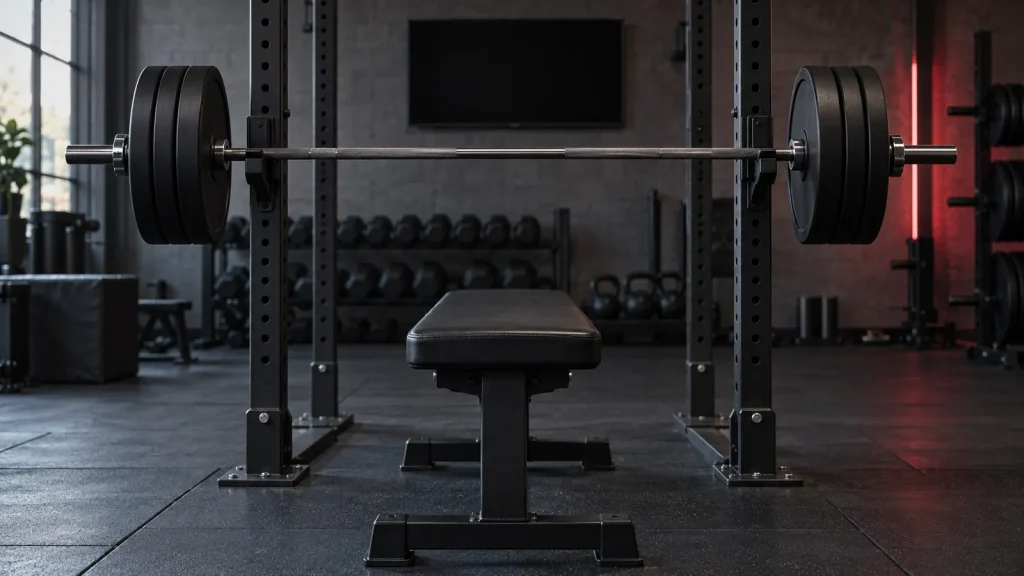
German Volume Training, or GVT, is a method of ten sets of ten reps on one main exercise. Strength coach Charles Poliquin popularized it. The idea is one big lift per muscle group, a moderate load, short rests, and enough total work to force adaptation.
The load is the odd part. You use about 60% of your one-rep max, which is close to a weight you could lift for 20 reps. That feels light on set one and far less so by set seven. In the version Outlift describes from Poliquin, rest is 60 seconds between sets and tempo is 2 seconds lifting and 4 seconds lowering. Other sources allow 60 to 90 seconds of rest and do not name a tempo.
Sources lay it out in different ways. StrengthLog runs three days a week, as our app does: chest and back, then legs, then arms and shoulders, with a rest day between sessions. Each main lift is 10x10.
Our in-app version is simplified: two exercises per day, 10 sets of 10 each, and no extra accessory work. Day 1 pairs bench press with chin-ups, day 2 pairs squats with leg curls, and day 3 pairs dips with barbell curls. Treat it as the core of the method, not the full routine from every article.

The schedule
Train on Monday, Wednesday, Friday, or any other days with rest between. Every set uses the same weight, the one you can lift for the written reps.
Day 1: Chest and back
| Lift | Sets and reps |
|---|---|
| Bench press | 10 x 10 |
| Chin-up | 10 x 10 |
Day 2: Legs
| Lift | Sets and reps |
|---|---|
| Squat | 10 x 10 |
| Leg curl | 10 x 10 |
Day 3: Arms and shoulders
| Lift | Sets and reps |
|---|---|
| Dip | 10 x 10 |
| Barbell curl | 10 x 10 |
Progression and stall rules
Add weight once all 100 reps are done
Finish all 10 sets of 10 with good form, then raise the load next time. Outlift says to add 4 to 5%; StrengthLog adds about 2% of your 1RM each week. The spreadsheet uses small fixed jumps instead, which is our simplification.
Start lighter than feels necessary
The first workout should feel easy for the first five or six sets. Around 60% of your 1RM, a weight you could lift about 20 times, is the standard start. The last three or four sets are where it bites.
Miss reps, hold the weight
If you drop to 7 or 8 reps on late sets, repeat the same weight next time. Do not cut rest to compensate. Keeping rest steady is how you tell whether you are really progressing.
Run it for a short block
StrengthLog suggests about 4 to 6 weeks, then a deload or a different program.
Weekly volume
Work sets per lift, counted from the schedule above (warm-ups not included).
| Lift | Sets per week |
|---|---|
| Bench press | 10 |
| Chin-up | 10 |
| Squat | 10 |
| Leg curl | 10 |
| Dip | 10 |
| Barbell curl | 10 |
Who it suits
A good fit
- Experienced lifters, with a couple of years of training behind them, who want a hard block to push muscle size.
- Lifters who can sleep well, eat enough protein and calories, and handle long, tiring sessions.
- Anyone stuck on 3 to 4 sets per exercise who wants to try much more volume for a short time.
Look elsewhere if
- Beginners. They grow well on far less volume and are better off on a simple full-body program.
- Lifters chasing a heavier one-rep max. The loads are light and the aim is size, not a new bench or squat record.
- Anyone in a hard calorie deficit or short on sleep. This much volume is difficult to recover from.
- Anyone who dislikes fatigue-heavy leg days.
Common mistakes
Starting at 70 or 80%
Starting heavier is the fastest way to fail by set six. Begin where the first sets feel too easy. The cumulative fatigue does the rest.
Cutting rest to look tough
Rest is the one thing you control. Keep it to the time you chose, 60 to 90 seconds, and track whether you still complete the reps. Shorter and shorter rests make the weight drop for the wrong reasons.
Using the same recipe on heavy leg lifts
Squats at 10x10 with a minute of rest are tiring. Start at the 20-rep weight, and if you must, rest a little longer on squats rather than dropping the weight.
Running it for months
It is a block, not a lifestyle. Stop after about 4 to 6 weeks, then deload or change program.
Assuming 10 sets must beat 5
The trials below suggest otherwise. If you stall mid-block, drop to 5 or 6 sets per exercise rather than grinding through all 10.
Your sample week
For each lift, enter: Weight you can lift for 10 clean reps with about 60 seconds rest (roughly a 20-rep max). The weights below update as you type. Your numbers stay in your browser and are not saved. The numbers shown are an example lifter.
Day 1: Chest and back
| Set | Reps | Weight (lb) |
|---|---|---|
| 1 | 10 | 135 |
| 2 | 10 | 135 |
| 3 | 10 | 135 |
| 4 | 10 | 135 |
| 5 | 10 | 135 |
| 6 | 10 | 135 |
| 7 | 10 | 135 |
| 8 | 10 | 135 |
| 9 | 10 | 135 |
| 10 | 10 | 135 |
| Set | Reps | Weight (lb) |
|---|---|---|
| 1 | 10 | 10 |
| 2 | 10 | 10 |
| 3 | 10 | 10 |
| 4 | 10 | 10 |
| 5 | 10 | 10 |
| 6 | 10 | 10 |
| 7 | 10 | 10 |
| 8 | 10 | 10 |
| 9 | 10 | 10 |
| 10 | 10 | 10 |
Day 2: Legs
| Set | Reps | Weight (lb) |
|---|---|---|
| 1 | 10 | 155 |
| 2 | 10 | 155 |
| 3 | 10 | 155 |
| 4 | 10 | 155 |
| 5 | 10 | 155 |
| 6 | 10 | 155 |
| 7 | 10 | 155 |
| 8 | 10 | 155 |
| 9 | 10 | 155 |
| 10 | 10 | 155 |
| Set | Reps | Weight (lb) |
|---|---|---|
| 1 | 10 | 70 |
| 2 | 10 | 70 |
| 3 | 10 | 70 |
| 4 | 10 | 70 |
| 5 | 10 | 70 |
| 6 | 10 | 70 |
| 7 | 10 | 70 |
| 8 | 10 | 70 |
| 9 | 10 | 70 |
| 10 | 10 | 70 |
Day 3: Arms and shoulders
| Set | Reps | Weight (lb) |
|---|---|---|
| 1 | 10 | 10 |
| 2 | 10 | 10 |
| 3 | 10 | 10 |
| 4 | 10 | 10 |
| 5 | 10 | 10 |
| 6 | 10 | 10 |
| 7 | 10 | 10 |
| 8 | 10 | 10 |
| 9 | 10 | 10 |
| 10 | 10 | 10 |
| Set | Reps | Weight (lb) |
|---|---|---|
| 1 | 10 | 55 |
| 2 | 10 | 55 |
| 3 | 10 | 55 |
| 4 | 10 | 55 |
| 5 | 10 | 55 |
| 6 | 10 | 55 |
| 7 | 10 | 55 |
| 8 | 10 | 55 |
| 9 | 10 | 55 |
| 10 | 10 | 55 |
The spreadsheet
The file has three sheets: your numbers, the full week with every weight as a formula, and a progress table that carries the weights forward. It opens in Excel, Numbers and LibreOffice. The weights in the link below use the numbers you typed above.
Open it in Google Sheets
- Download the .xlsx file above.
- Go to Google Drive and choose New, then File upload, and pick the file.
- Double-click the uploaded file and choose Open with Google Sheets.
- Choose File, then Save as Google Sheets so you can edit it.
Want the weights to follow you into the gym? Create a free account and the program loads into Train for you.
How it compares
German Volume Training vs Bro split
A bro split trains one muscle a day with three or four exercises of three to four sets. GVT uses one or two lifts per day with ten sets each, which is more work per exercise and less variety. Read the Bro split guide.
German Volume Training vs Arnold split
The Arnold split gets its volume from many exercises across six days. GVT concentrates it on a couple of lifts across three days, so sessions are shorter but each set is more repetitive. Read the Arnold split guide.
German Volume Training vs Push pull legs
Push pull legs spreads moderate volume across several lifts and hits each muscle twice a week. GVT puts a large dose on one lift at a time and is easier to burn out on. Read the Push pull legs guide.
Load German Volume Training into Train and log each session against the plan.
Start it in Symmetric StrengthThe workouts in Train are a simplified version of this program, with one rep count per lift. Use the schedule above for the exact sets.
Common questions
What is German Volume Training?
A method of 10 sets of 10 reps on one main exercise per muscle group, at about 60% of your one-rep max with short rests. It is usually run as a block of a few weeks aimed at muscle size.
How much weight should I use for GVT?
About 60% of your 1RM, roughly the weight you could lift 20 times. Type in the weight you can do for 10 clean reps with about a minute of rest, and the spreadsheet fills in your sessions. If you only know your 1RM, multiply it by 0.6 and round down.
How long should I rest between sets?
Poliquin's version, as one source reports it, is 60 seconds. Another suggests 60 to 90 seconds and longer rests late in the block. Pick one and keep it the same so your progress means something.
Is German Volume Training better than normal training?
The evidence does not say so. In a 2017 trial by Amirthalingam and colleagues, 19 men did 10 or 5 sets of 10 for six weeks. Both groups gained lean mass and strength, and the 5-set group gained more bench press and lat pulldown strength. In a 12-week pilot with 12 men, 10 sets did not beat 5, and lean leg mass fell in the 10-set group between weeks 6 and 12. Both trials were small.
What is the GVT workout schedule?
Three sessions a week with a rest day between them: chest and back, legs, then arms and shoulders.
How fast should I add weight on GVT?
Once all 10 sets of 10 are done with good form, Outlift says to raise the load by 4 to 5%. StrengthLog adds about 2% a week. If you cannot finish the reps, stay at the same weight.
Can I do GVT to lose fat?
It will not burn fat on its own. Fat loss still needs a calorie deficit, and a hard deficit makes the volume harder to recover from. Cut volume if you are dieting.
Know where you stand
Before you start, check how your lifts compare on the strength standards, estimate a max with the one-rep max calculator, or score your total with the DOTS calculator.
Sources and credit
German Volume Training was popularized by Charles Poliquin. We describe the method in our own words from the linked summaries and the research literature, which differ in detail. The 2017 study cited is Amirthalingam et al., Journal of Strength and Conditioning Research, 31(11):3109-3119.
- German Volume Training: the plan to build muscle (StrengthLog)
- German Volume Training (Outlift)
- Effects of a 12-Week Modified German Volume Training Program on Muscle Strength and Hypertrophy: A Pilot Study (Hackett et al., Sports 2018, PMC)
Checked . Symmetric Strength is not affiliated with Charles Poliquin or his estate. Program names are used only to identify the programs.